
Walk into any modern innovation hub, join a venture capital briefing, or scroll through executive profiles on networks like LinkedIn, and you will immediately notice a dense layer of terminology. Founders frequently identify their ventures using layered descriptions like AI SaaS startup, B2B enterprise platform, or consumer-focused subscription model. While these labels are foundational to the modern commercial lexicon, they are routinely used interchangeably or incorrectly. This misapplication goes beyond simple semantics. Misclassifying a company distorts strategic positioning, skews investor benchmarking, confuses target demographics, and creates friction in go-to-market execution. A software firm that markets itself strictly as a product-oriented tech business while operating on a high-touch corporate account blueprint risks alienating its primary buyers.
The structural root of this confusion is the assumption that a startup must fit cleanly into a single, comprehensive bucket. In reality, corporate taxonomy is multi-dimensional. A business does not choose between being SaaS, B2B, or a startup. It occupies a specific position across several independent operational variables simultaneously. To classify an entity accurately, you must isolate who the company serves, how the product is engineered and distributed, and how value is monetized.
Understanding these distinctions requires breaking down the core identity of a venture into distinct, measurable layers. By separating growth velocity from customer types and delivery architectures from revenue engines, founders and analysts can evaluate any modern enterprise with high precision.
Every Startup Has More Than One Identity
An accurate corporate classification requires analyzing a business through a matrix of distinct operational attributes rather than searching for one overarching name. A single commercial entity possesses multiple, overlapping identities that address completely different fundamental questions about its mechanics.
To map a company accurately, look at five specific business dimensions.
First, its lifecycle position dictates its operational maturity and growth mandate. This defines whether the business is classified as a startup, a scale-up, or a mature legacy enterprise.
Second, the target customer category identifies the economic buyer. This determines if the operation functions as a business-to-business network or a business-to-consumer outlet.
Third, the technical architecture explains the product deployment mechanism. This clarifies whether the platform operates as Software as a Service or a local native application.
Fourth, the ecosystem model maps how market participants interact. This defines whether the platform functions as a centralized utility or a multi-sided marketplace.
Fifth, the revenue architecture tracks how cash flow is extracted. This dictates whether the financial model relies on recurring subscriptions, consumption-based billing, or flat transaction fees.
Consider Salesforce to see this multi-layered framework in practice. It is a mature enterprise software corporation. It builds cloud-hosted software, meaning it belongs to the SaaS delivery category. Its economic targets are corporations, placing it firmly in the B2B domain. It monetizes via contractual recurring subscriptions, and its primary industrial vertical is customer relationship management. Each layer coexists without contradiction because each answers a different operational question.
The same multidimensional reality applies to consumer giants like Spotify. It operates a digital media delivery system that uses a B2C model to serve individual listeners. It handles billing through a hybrid freemium and subscription model while relying on a centralized platform architecture rather than a peer-to-peer marketplace.
By analyzing companies using these separate tracks, you eliminate the confusion caused by mixing delivery methods with audience profiles.
Start with the Company’s Stage, Not Its Product
Before evaluating a company’s product line or technical architecture, you must establish its position within the business lifecycle. The term startup is frequently misused as an umbrella term for any newly formed entity or technology-enabled small business. However, institutional networks like Y Combinator and Techstars define a startup by its systemic capacity for rapid, geometric growth, rather than its calendar age or choice of tools.
A true startup is an organization formed to search for a repeatable, highly scalable business model in conditions of high uncertainty. Traditional small businesses, such as regional consulting agencies or local retail outlets, generally target linear growth within fixed geographic constraints. Startups build systems where the marginal cost of serving an additional user trends toward zero, allowing them to target vast international markets rapidly.
The progression of a high-growth venture follows a structured sequence of operational phases. Each phase requires different capital structures, metrics, and risk profiles.
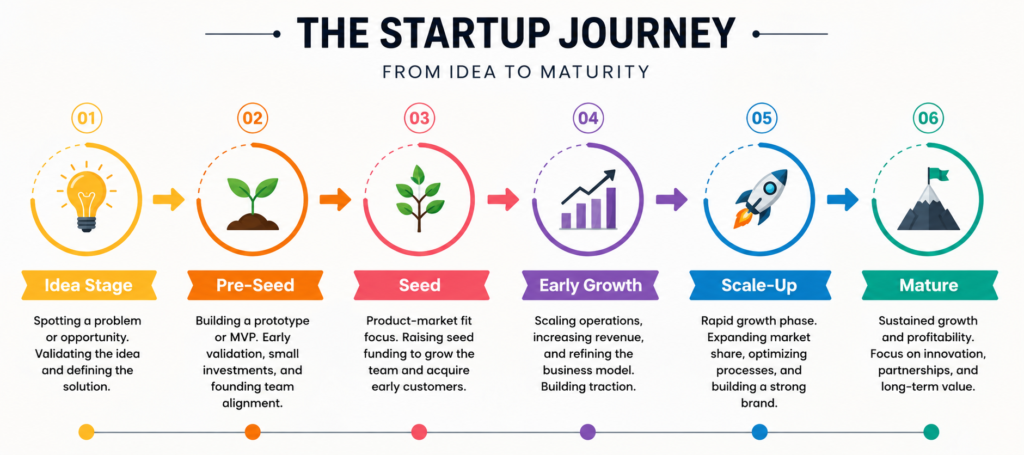
- Idea Stage focuses on initial hypothesis validation, customer discovery interviews, and core problem mapping.
- Pre-Seed Stage is centered on engineering a minimum viable product and securing initial capital from founders or angel networks.
- Seed Stage dedicated to proving product-market fit, establishing initial unit economics, and acquiring early customer cohorts.
- Early Growth Stage focused on scaling customer acquisition channels, building out leadership teams, and stabilizing institutional revenue.
- Scale-Up Stage prioritizes efficient, programmatic expansion across international territories or enterprise market segments.
- Mature Business Stage is characterized by predictable corporate operations, defensive market share preservation, and optimized margins.
Isolating a company’s lifecycle phase is essential because startup status is an evolutionary milestone, not a permanent revenue model. A business can transition from an agile, loss-making startup into a highly stable corporate utility while keeping its core software delivery model completely unchanged.
Your Customer Defines the Business Category
Once you establish a firm’s operational maturity, the next step is identifying its primary economic buyer. This layer isolates the source of capital entering the business, dividing the landscape into distinct engagement tracks.
When Businesses Are the Customer
A B2B company sells its products, services, or data streams exclusively to other corporations, institutions, or government agencies. The operational mechanics of a B2B model are shaped by institutional logic, financial accountability, and risk management.
Purchasing decisions in the corporate space are rarely driven by individual choice. Procurement involves structured evaluation committees where department managers, security compliance officers, legal counsel, and chief financial officers all influence the final decision.
Because of these institutional layers, B2B companies operate with distinct commercial characteristics.
- Extended sales cycles requiring months or quarters of negotiation, technical evaluation, and security reviews.
- Substantial contract values are often structured as annual contract value or total contract value with formal service level agreements.
- Multi-stage approval funnels that require formal requests for proposals and rigorous information security clearances.
- Deep integration needs require the new solution must connect directly with existing corporate systems via enterprise application programming interfaces.
- Dedicated post-sale support infrastructure managed by customer success teams to protect net revenue retention.
Market leaders like Stripe, HubSpot, Slack, and Snowflake operate strictly within this corporate framework. Their entire business model, from account-based marketing to enterprise-grade data compliance, is engineered around institutional procurement.
When Individuals Are the Customer
A B2C company sells products, digital assets, or services directly to individual consumers for personal use. The commercial framework of a consumer business is built on volume, friction-less onboarding, and user experience.
The individual consumer is typically the sole decision-maker and the direct end user. This alignment eliminates the need for procurement approvals, corporate budget cycles, or legal sign-offs. As a result, the time from product discovery to conversion can be measured in minutes or seconds.
To sustain growth, B2C operations rely on specific structural mechanics.
- High transaction volumes to balance out lower average revenue per user.
- Self-service conversion funnels designed to minimize user onboarding friction.
- Heavy reliance on digital advertising, viral loops, influencer networks, and broad brand equity.
- High exposure to customer churn requires constant focus on user engagement, gamification, and habit loops.
- Pricing strategies focused on consumer psychological benchmarks, disposable income levels, and micro-transactions.
Global consumer platforms like Netflix, Duolingo, and Spotify are clear examples of this operational model. Their financial health depends on maintaining millions of active, low-friction consumer accounts.
Some Companies Serve Both Markets
Many modern tech companies do not fit perfectly into a single category. Instead, they use a hybrid model known as B2B2C. This approach combines institutional distribution with consumer-facing utilization.
In a B2B2C framework, the tech company sells its platform to a corporate partner. However, that partner provides the interface directly to their own consumer base. The end consumer uses the service under the brand of the enterprise partner or via a co-branded integration.
Consider the buy-now-pay-later platform Affirm. It sells its financial integration directly to e-commerce merchants to improve shopping cart conversion rates. However, the end users are everyday shoppers selecting payment installments at checkout.
To scale successfully, a B2B2C business must solve two distinct problems simultaneously: it must deliver measurable commercial value to its enterprise clients while maintaining a simple, appealing product experience for end consumers.
SaaS Describes How Software Is Delivered
One of the most persistent errors made by founders and market analysts is treating SaaS as a category of customers. SaaS is not an audience type. Software as a Service is a technical deployment mechanism and architectural model. It specifies how code is hosted, run, and updated.
In a traditional software model, applications were sold via perpetual licenses and installed directly onto physical hardware on-premises. The client assumed full responsibility for maintaining servers, managing databases, and performing manual upgrades.
The SaaS architecture replaces this local installation model with centralized cloud computing.
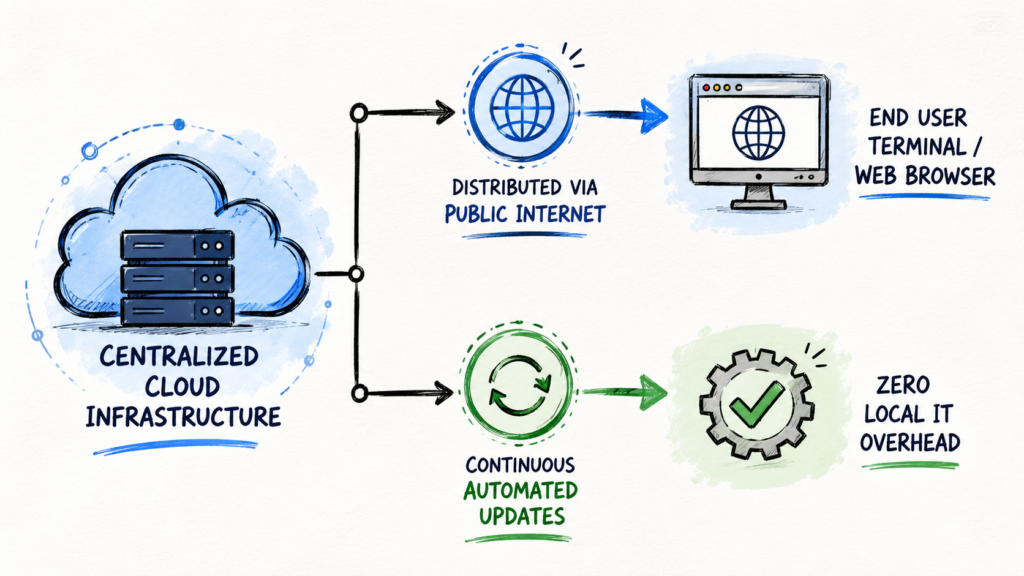
A true SaaS platform runs on remote servers managed entirely by the software provider. Users access the application over the internet using standard web browsers or thin native apps.
This cloud-hosted distribution model relies on a specific set of core operational elements.
- Centralized single-tenant or multi-tenant cloud hosting managed on external infrastructure like Amazon Web Services or Google Cloud.
- A utility-based or subscription payment system that replaces large, upfront capital expenditures with predictable operating expenses.
- Continuous delivery pipelines that roll out performance enhancements and security patches automatically without user disruption.
- Elastic scaling infrastructure that adjusts computing resources based on user activity.
Because SaaS defines the technical distribution method rather than the target customer, it applies equally well across B2B and B2C markets.
- Salesforce delivers relationship management software to enterprises via the cloud, making it a B2B SaaS.
- HubSpot provides inbound marketing software to corporate marketing teams over the web, making it a B2B SaaS.
- Canva serves corporate marketing teams alongside individual creators through a web-based design engine, making it a Hybrid SaaS.
- Notion distributes productivity workspaces to international enterprises and individual students alike via the cloud, making it a hybrid SaaS.
- Zoom routes video communications for global corporate boards and informal social groups through a cloud native app, making it a hybrid SaaS.
When you treat SaaS as an architectural delivery model rather than a customer profile, you can immediately see how a company can be SaaS and B2B, or SaaS and B2C, at the same time.
Why Subscription Doesn’t Always Mean SaaS
A common point of confusion is treating subscriptions and SaaS as the same thing. This error mixes up the revenue model with the delivery method. Subscriptions define the billing schedule. SaaS defines the product delivery architecture.
Many subscription-based businesses do not sell software at all. For example, Netflix charges a recurring monthly subscription fee, but it is not a SaaS company. Its subscribers are paying for access to an entertainment media library, not a productivity tool or software utility. Netflix uses complex cloud tech to stream video, but its core product is digital content.
The same distinction applies across other industries. Digital newspapers like The New York Times and curated physical commerce businesses use subscription billing models without operating as SaaS platforms.
To classify these models accurately, ask whether the customer is paying for ongoing access to cloud-hosted software or recurring access to static content, physical products, or services.
Why Modern Startups Need More Than One Classification
When you evaluate a company across multiple dimensions rather than trying to fit it into a single category, its operational model becomes much clearer.
Consider a modern, AI-enabled corporate tax automation platform. Instead of labeling it loosely as just a tech business, you can analyze its identity using five specific layers.
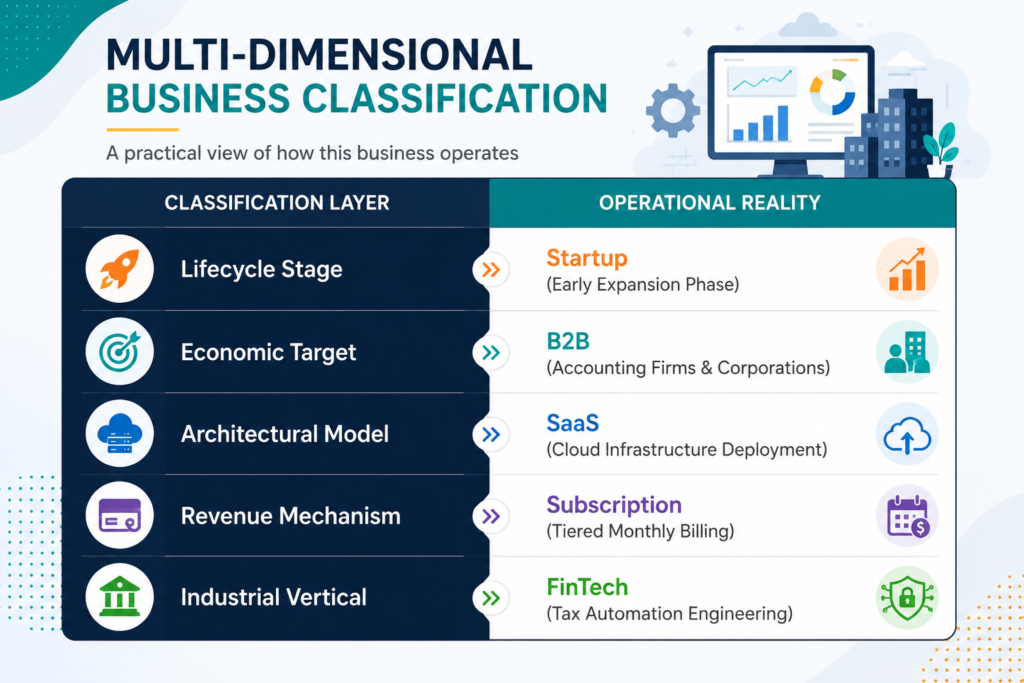
This multi-layered approach gives a complete look at the company’s real mechanics. It shows how the business works, who it sells to, how it charges, and what technology it uses to scale.
Marketplace, Platform, and Other Business Models That Often Get Confused
To build a precise classification framework, you must distinguish between the core business engines that drive tech companies. Founders often mislabel their companies as SaaS simply because they operate online, which obscures their true economic mechanics.
Marketplace Businesses
A digital marketplace does not design, manufacture, or stock its own inventory. Instead, it acts as a network facilitator. Its main function is to connect independent buyers with independent sellers, earning a fee for managing the transaction.
Marketplaces generate revenue through transaction commissions, listing fees, or promoted visibility rather than fixed monthly software subscriptions.
- Airbnb matches properties owned by independent hosts with international travelers seeking lodging.
- Uber connects independent drivers with passengers requiring local transportation.
- Etsy links artisan creators with consumers searching for handmade goods.
The core challenge for a marketplace startup is managing the network effect. The platform only creates value when it balances supply and demand simultaneously. If there are no service providers, users leave; if there are no users, service providers abandon the system.
While some marketplaces eventually build software tools for their vendors, their core business model remains transactional and network-driven.
Platform Businesses
A platform business builds foundational technical infrastructure that other companies, developers, and ecosystems rely on to run their own products.
Platforms do not just provide a standalone application; they become the underlying operating environment for other systems.
- Amazon Web Services provides the foundational cloud infrastructure and storage that power internet applications.
- Twilio provides the communications infrastructure that allows developers to embed messaging and voice into their apps.
- Stripe provides the payment infrastructure that enables internet companies to process global financial transactions.
Platform companies often use consumption-based or transaction-based pricing, charging clients based on their exact data usage or volume of financial transactions.
E-commerce Businesses
Operating an online storefront does not make a company a software business. A digital retail startup is classified as an e-commerce business because its primary value comes from selling physical products.
An online apparel brand or direct-to-consumer furniture company relies on logistics, inventory management, supply chain networks, and manufacturing margins. They are consumers of SaaS tools to run their storefronts, but their own business engine is retail commerce.
A Practical Framework for Classifying Any Startup
To analyze any technology venture accurately, avoid searching for a single corporate label. Instead, work through a sequence of four specific operational questions.
Step 1: Establish Lifecycle Maturity
Determine if the enterprise is still validating its product, chasing high-velocity scale, and building out its core distribution channels. If it is prioritizing market expansion over near-term profit stabilization, it falls into the startup or scale-up phase.
Step 2: Pinpoint the Primary Economic Buyer
Track where the money comes from. If the buyer is a corporate entity with structured procurement, classify the target market as B2B. If the buyer is an individual consumer spending disposable income, classify the market as B2C. If the platform uses enterprise relationships to reach consumers, classify it as B2B2C.
Step 3: Map the Product Type and Delivery System
Examine what the company actually sells and how it delivers that value to the end user.
- Cloud-hosted applications accessed over the web match the SaaS delivery model.
- Physical inventory sold via an online storefront matches the E-commerce model.
- Facilitating connections between independent buyers and sellers matches the Marketplace model.
- Providing foundational infrastructure for other developers matches the Platform model.
Step 4: Identify the Revenue Mechanism
Isolate how the business captures economic value. The most common modern monetization models include fixed recurring subscriptions, variable usage-based pricing, flat transaction fees, and advertising monetization.
Read More: B2B and B2C eCommerce: How Selling to Businesses Differs from Selling to Consumers
How Well-Known Companies Are Classified
To see how these layers work together, look at how the world’s leading technology enterprises are mapped across different categories.
- Salesforce sells to B2B customers using a SaaS delivery model with a Subscription revenue engine. This makes its overall classification an Enterprise B2B SaaS Platform.
- HubSpot serves B2B clients through a SaaS delivery system powered by Subscription billing. It is classified as an Inbound Marketing and CRM B2B SaaS.
- Canva reaches a hybrid B2B and B2C audience via a SaaS model using a Freemium and Subscription structure. It is classified as a Hybrid Creator SaaS.
- Notion accommodates both B2B and B2C users with a SaaS system using Freemium and Subscription tiers. It operates as a Productivity and Workspace SaaS.
- Shopify targets B2B merchants via a SaaS architecture while combining Subscription and Transaction pricing. It is a Commerce Enablement B2B SaaS Platform.
- Zoom connects B2B and B2C users through a SaaS engine using Freemium and Subscription billing. It is classified as a Cloud Communication SaaS.
- Airbnb focuses on a B2C target audience through a Marketplace delivery model powered by Transaction Fees. It operates as a Two-Sided Lodging Marketplace.
- Uber handles a B2C consumer base using a Marketplace architecture funded by Transaction Fees. It maps as a Mobility and Logistics Marketplace.
- Spotify monetizes a B2C audience via a Streaming Platform funded by Subscription and Advertising. It is classified as a Consumer Digital Media Subscription Service.
- AWS provisions infrastructure to B2B entities using a Cloud Platform architecture with Usage-Based pricing. It operates as a Cloud Infrastructure Platform.
- Stripe powers B2B enterprises via a Financial Platform deployment model using Transaction Fees. It functions as a FinTech Infrastructure Platform.
- OpenAI serves a combined B2B and B2C market through AI SaaS and APIs using Subscription and Consumption billing. It is classified as an Artificial Intelligence Platform.
These profiles show why single-word labels are not enough to explain how modern tech corporations operate.
Why Classification Influences Business Strategy
Choosing the correct business classification is an important strategic step that guides how a company grows. Every category requires a different operational focus, capital efficiency benchmarks, and product engineering.
Product engineering priorities change based on the target market. A B2C consumer application must prioritize immediate onboarding, low-friction user interfaces, and engaging design to prevent user churn.
A B2B enterprise platform, by contrast, must dedicate engineering resources to complex administrative settings, role-based access permissions, data residency compliance, and integrations with existing systems.
Go-to-market strategies are also shaped by these classifications. A corporate B2B SaaS model requires an account-based marketing approach, building out an inside sales team, and setting up customer success structures to maximize net revenue retention.
A consumer B2C marketplace relies instead on performance marketing, viral loops, search engine optimization, and brand building to handle high user churn and low average transactional values.
Financing strategies and corporate evaluation metrics are closely linked to these categories. Institutional venture funds analyze startups by comparing them directly against peers with the same business engine.
A B2B SaaS startup is judged on its Annual Recurring Revenue growth, Net Revenue Retention, and LTV to CAC ratio. A marketplace startup is measured instead by its Gross Merchandise Volume, Take Rate, and Liquidity Dynamics. Misclassifying your venture can lead to tracking the wrong metrics, resulting in poor resource allocation and friction during fundraising rounds.
Frequently Asked Questions
Can a startup be both SaaS and B2B?
Many business software companies fall directly into this category. SaaS describes the cloud-hosted architecture used to deploy the application, while B2B identifies other corporations as the target economic buyers. Salesforce, HubSpot, and Slack are clear examples of B2B SaaS.
Is every SaaS company B2B?
Many SaaS companies build applications for individual consumers, students, or creators. Canva, Notion, and Zoom provide web-delivered software while supporting a mix of individual consumer accounts and large corporate clients.
What is the difference between a startup and a SaaS company?
The term startup describes a specific phase in a company’s lifecycle characterized by rapid growth ambitions and the search for a scalable model. SaaS refers specifically to a technical architecture where software is run in the cloud and delivered over the internet. A startup can use a SaaS model, but it can also operate as an e-commerce brand or a transactional marketplace.
Is every subscription business considered SaaS?
Subscription pricing is simply a billing method, whereas SaaS is a product architecture. Media platforms like Netflix use subscription billing models but are classified as digital streaming services rather than SaaS companies because they sell access to content libraries rather than software utilities.
How do investors classify startups?
Venture capital firms evaluate companies using a multi-dimensional matrix. They look at lifecycle maturity, target customer profiles, technical delivery models, monetization strategies, and specific industrial verticals to benchmark performance accurately against true market competitors.