Building a working AI mental health app is no longer the hard part. Foundation models, fine-tuning tools, and real-time voice have cut the time to a usable product from years to weeks. The hard part is building a business that survives contact with a payer.
Woebot is the cleanest cautionary tale. It reached roughly 1.5 million users and raised $90 million in Series C funding in 2021, yet it shut down its consumer app on June 30, 2025. Founder Alison Darcy told STAT that the cost and difficulty of meeting FDA marketing authorization requirements drove the decision. Usage was never the problem.
Interest and willingness to pay are two different things. Someone in the middle of burnout will happily download a free tool, then cancel the week things improve. Meanwhile, employers, health plans and health systems will pay real money, but only after they see clinical evidence, tight security and a clear return.
That split creates three paths: business-to-consumer (B2C), business-to-business (B2B) and the hybrid business-to-business-to-consumer (B2B2C). Each one comes with its own margins, sales motion and compliance load. The path you choose also decides how you build the product, what data you touch and who you hire first.
How AI Mental Health Startups Make Money
Every company in this space sits between a digital intervention and the party willing to fund it. The pitch is usually some blend of wider access, less clinical paperwork, faster triage or support that exists outside a 50-minute therapy slot. What trips up many founders is that the person using the product is rarely the person paying for it.
Revenue model and distribution strategy are also not the same thing. Distribution is how the product reaches people, such as app store marketing, channel partners or an enterprise sales team. The revenue model is how you capture value once it arrives, whether through subscriptions, per-member fees, usage charges or licensing.
Most companies draw from five streams, often combining two or three of them.
- Consumer subscriptions for conversational AI, self-guided CBT modules, or mood analytics.
- Employer and enterprise contracts paid by organizations that offer the tool as a benefit.
- Clinician and provider software for intake, note drafting, and care navigation.
- Technology licensing and APIs sold to larger platforms and insurers.
- Hybrid human-in-the-loop services that add licensed therapists or coaches on top of an AI front line.
Your choice sets your cost structure. A consumer app burns cash on performance marketing to replace churned users. A clinician co-pilot needs Electronic Health Record integration, strict medical privacy compliance and a slower sales cycle.
One rule holds across all of them. The closer a product moves toward diagnosis, treatment claims or crisis triage, the more it costs to operate. Higher contract values, institutional backing or premium pricing have to absorb that cost, or gross margin vanishes.
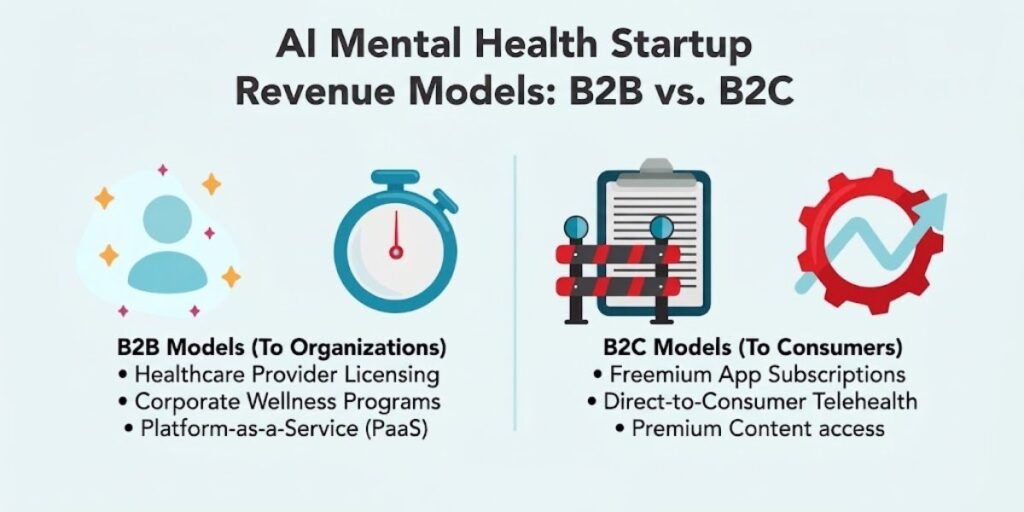
B2C Revenue Models for AI Mental Health Startups
Selling direct is the fastest way to find out whether anyone cares. You can ship to the app stores, watch where people drop off in onboarding and rewrite the flow within days. No procurement committee, no security questionnaire. Sustaining that speed is where it gets expensive.
Four levers drive most consumer revenue. A freemium tier caps daily messages. Paid plans, monthly or annual, remove the cap. In-app purchases cover things like self-paced workbooks. Premium add-ons connect users to credentialed coaches or licensed therapists.
Demand is clearly there. A JAMA Network Open study found that about 13% of people aged 12 to 21 reported using generative AI for mental health advice, with higher use among 18 to 21-year-olds, as TechInformed reported. Turning that curiosity into recurring revenue is the difficult part.
Free-to-paid conversion for consumer wellness apps typically sits between 2% and 5%. Mental health needs also follow life events, so engagement often falls off a cliff once a stressful period ends. Monthly churn of 10% to 15% is common, which means you spend every month rebuilding the base you lost.
Acquisition costs make it worse. Search and social ads for mental health keywords are pricey because every competitor bids on them. When customer acquisition cost (CAC) climbs above customer lifetime value (LTV), a long download chart means nothing. Founders tend to underestimate how much of a B2C budget goes to replacing users instead of growing the base.
Trust is a quieter problem. People hesitate to type out suicidal thoughts or relationship details to a bot, and past data leaks across digital health have made them pickier about which app gets their card. Winning that trust takes time and visible safeguards.
Finally, a big registered base can hide a losing business. Every free-tier message triggers server, API, and model inference costs. If too few active users convert into long-term subscribers, growth simply widens the loss.
B2B Revenue Models for AI Mental Health Startups
Selling to organizations removes the grind of acquiring users one at a time. The payer becomes a company, clinic, health system, or insurer, and those buyers hold budgets earmarked for cutting costs, managing risk, and keeping people. In exchange, you accept a longer and harder sale.
Employer Contracts and Per-Member Pricing
Employers carry high indirect costs from burnout, absenteeism, and lost productivity, plus direct spending through insurance claims. That makes them one of the biggest buyers of preventive mental health tools.
Contracts usually follow one of three structures.
- A flat per-employee-per-month (PEPM) fee.
- A per-member-per-month (PMPM) rate inside a health plan deal.
- An active-user model, with a base administrative fee plus a charge for each employee who engages.
Procurement is thorough. HR leaders, benefits brokers and chief medical officers dig into privacy standards, compliance posture and evidence of clinical safety. They also want ironclad assurance that transcripts, usage data and mental health metrics stay anonymous and invisible to management.
Renewal comes down to engagement. Employers review utilization at every annual evaluation, and when adoption drops under roughly 5% to 8% of eligible staff, many decide the service is underused and cancel. Launch campaigns and steady internal communication belong in your retention plan from day one.
Software for Therapists, Clinics, and Healthcare Providers
Many founders skip patient-facing coaching and build for the clinician instead. The pain point is easy to see. Practitioners can lose 20% to 30% of their working hours to clinical notes, intake forms, billing claims and diagnostic coding.
Pricing tends to follow three paths: monthly subscriptions per practitioner, tiered plans for group practices and clinics, and add-on modules such as between-session risk tracking or automated psychometric assessments.
Where you sit on the risk spectrum matters a great deal. Ambient transcription, SOAP note drafting and scheduling are administrative infrastructure. The clinician reviews and signs everything, so liability stays low and procurement moves quickly.
Law is already drawing that line. Illinois signed the Wellness and Oversight for Psychological Resources Act in August 2025. It bars AI from therapeutic decision-making but explicitly allows administrative and supplementary support for licensed professionals, such as preparing therapy notes. Clinicians must also give patients written notice and obtain consent before using AI in a session, according to this legal summary. A scribe fits that rule easily. A chatbot that offers coping advice does not.
Tools that suggest diagnoses, recommend interventions, or score patient risk live in clinical decision support territory. Expect closer regulatory attention, validation studies, and slower sales. The FDA updated its Clinical Decision Support and General Wellness guidance in January 2026, so read it before you finalize positioning. The payoff for clearing that bar is bigger annual contracts, because the value connects directly to care quality and lower medical spend.
Licensing and Usage-Based Revenue
If you own a strong model, a distinctive dataset or a proven conversational framework, you can license it instead of selling a finished product. You become the engine inside someone else’s offering and never manage the end-user relationship.
Deals generally take one of three forms.
- White-label licenses for insurers or hospital networks.
- API and compute-based fees tied to call volume or token use.
- Data and content partnerships with research institutions or pharmaceutical companies.
Fixed fees and usage pricing pull in opposite directions. A flat license gives you predictable cash for hiring and research. But if the client rolls the product out to millions of members, the cap leaves money on the table.
Usage pricing captures that growth. The cost is volatility. If the client trims marketing, redesigns its member portal or hits a seasonal lull, your revenue falls the same week. Most enterprise vendors land on a base platform fee plus usage tiers, which protects the floor and keeps the upside open.
B2B vs. B2C: Which Revenue Model Makes More Sense?
Neither model wins on paper. They simply demand different things from a team, and the wrong fit burns cash fast.
B2C gives you direct control over design, onboarding and feature testing. Feedback arrives in hours, and you can ship a change the same day. The cost of that control is a marketing treadmill. Switching costs are tiny and churn is high, so a big share of incoming revenue goes straight back into ads just to hold the subscriber count steady.
B2B flips the trade. Contract values are higher, renewals are stickier and a signed health system or large employer becomes a real moat. A Fortune 500 contract can lock in recurring revenue for several years. The price is time. Enterprise cycles often run 6 to 18 months, with security audits, legal redlines, clinical review panels and custom integrations. Plenty of startups run out of runway before the first signature lands.
So match the model to the team. Founders with clinical research backgrounds and compliance experience are built for enterprise sales. A team of growth marketers and product designers will move faster in consumer, as long as they get unit economics right early. I would add that capital matters as much as skill. A B2B plan with eight months of cash is mostly a hope, not a plan.
Read More: How to Classify a Startup: Understanding SaaS, B2B, B2C, and Modern Business Models
How Hybrid B2B2C Models Work
Many maturing platforms end up here after bumping into the limits of both pure models. B2B2C pairs institutional funding and distribution with consumer-grade product design.
The mechanics are simple. A startup signs a payer, self-insured employer, or regional health network, which sponsors the product. Members, employees, or patients then get access free or at a steep discount. The startup earns a baseline institutional fee and can still sell optional premium features directly to users who want more.
Three advantages follow. Channel distribution cuts acquisition costs. A consumer-quality interface lifts daily engagement. And the baseline fee is paired with an upsell path that pure B2B cannot offer.
The hard part is serving two customers with opposing instincts. The buyer cares about security, risk, outcomes and cost reduction. The user cares about privacy, speed and whether the app actually feels helpful.
Lean too far toward the buyer and the product feels like corporate surveillance. People stop opening it, utilization collapses and the renewal dies. Lean too far toward the user and you cannot hand the sponsor anonymized population reports or outcome data, so the funding disappears. In practice, B2B2C succeeds or fails on whether you can deliver both at once.
What It Costs to Run an AI Mental Health Startup
Top-line revenue tells you very little until you subtract delivery costs. AI mental health platforms carry heavier technical, clinical and operational overhead than ordinary SaaS.
Six cost centers dominate. AI infrastructure and model inference come first, since every conversation burns tokens. Engineering follows, covering architecture, mobile apps, testing and integrations. Support and crisis triage need trained humans and defined escalation protocols. Security, compliance, and legal cover audits, certifications, and healthcare counsel. Marketing and sales mean ad spend or enterprise reps. Clinical oversight pays medical advisors, psychologists, and licensed therapists.
Unit economics decide whether the model lives. You need a healthy LTV to CAC ratio and positive gross margin after compute and human review costs.
Run the numbers on a consumer app charging $12 per month. If cloud compute, inference, and safety monitoring eat $4 per user, gross profit is $8 a month. At a $60 acquisition cost, you need about 7.5 months of retention just to recover CAC, before engineering or overhead. With monthly churn between 10% and 15%, the average user leaves right around the break-even point. That is the quiet math killing many consumer apps.
Compare a clinician co-pilot at $300 per practitioner per month. Administrative prompts are cheap to run, and practitioners rarely leave once the tool lives inside their daily workflow. Margins stay stable, and the company can afford a long sales payback period and a high-touch sales team.
How Privacy, Safety, and Clinical Oversight Affect Revenue
In this category, how you design for safety and define your intended use determines your market, your liability and your revenue ceiling. Compliance is part of the business model.
Mental health apps handle journal entries, behavioral logs and medical history. Buyers expect HIPAA compliance backed by Business Associate Agreements, SOC 2 Type II certification, zero data retention for model training and strong encryption in transit and at rest. Skip these and enterprise doors stay shut.
Crisis handling is non-negotiable. The system has to watch for acute distress, self-harm language and threats of violence. When it detects risk, it should drop out of normal generation and switch to clinically validated protocols, such as surfacing local crisis hotlines or alerting a human reviewer. A failure here can get you pulled from app stores or dropped by an enterprise client overnight.
The FDA is also paying close attention. Its Digital Health Advisory Committee met on November 6, 2025, to discuss generative AI in mental health devices. Briefing materials noted that none of the more than 1,200 AI-enabled devices then authorized covered mental health conditions. Recent reporting puts the authorized total above 1,500 as of August 2026, still with no generative AI product cleared for mental health treatment.
Positioning is the first big decision. Marketing a product as general wellness, stress management, or self-improvement lets you launch without a formal FDA review. But you cannot claim to diagnose, treat, or prevent a condition like major depressive disorder. That keeps you in consumer wallets and corporate wellness budgets and out of healthcare reimbursement.
State law adds another layer. Illinois allows civil penalties of up to $10,000 per violation, and its reach extends to wellness app developers. Marketing phrases like therapist-like or 24/7 emotional support aimed at Illinois users may be read as offering AI therapy. Counsel there recommends geofencing or licensed oversight for any restricted feature.
Going clinical changes the economics. Software that claims to treat a condition becomes a regulated medical device and needs trials, quality systems, and years of work. The reward is reimbursement. Since 2025, Medicare pays for digital mental health treatment through codes G0552 to G0554, but only for prescription devices cleared under 21 CFR 882.5801. A chatbot sold as wellness cannot bill them.
Clearance does not guarantee a smooth ride. Rejoyn, the first prescription digital treatment for major depressive disorder, was cleared after a trial of 386 adults, and critics noted the study did not show a statistically significant benefit. They also pointed out that clearance does not secure insurance approval. Funding follows validation, though. Big Health raised $23.7 million to expand SleepioRx and DaylightRx after the Medicare codes arrived.
Even a designation is no guarantee of survival. Woebot’s postpartum program won FDA Breakthrough Device Designation in 2021, and the company still pulled its consumer app four years later.
Choosing the Right Revenue Model for an AI Mental Health Startup
There is no universally right answer. The right model is the one where your product, your buyer’s budget and your team’s strengths all point the same way.
Five questions usually settle it.
- Who has the money? A person paying out of pocket, an employer with a benefits budget or a clinic buying time back.
- How long can you wait for revenue? Consumer cash arrives quickly. Enterprise cash takes a year or more.
- What do you do that others cannot? A real clinical or technical edge supports B2B pricing. A thin wrapper around a general model rarely does.
- Do the unit economics hold? Check LTV against CAC after compute and human review costs.
- Can you handle compliance? Security audits, state laws, and FDA positioning each need an owner.
Be honest about the last two. Most failed plans I have seen leaned on optimistic retention and ignored compliance until a buyer asked about it.
The strongest model is not the one with the biggest projected revenue. It is the one that links a real mental health need to an affordable way of finding customers and a delivery structure that stays profitable while keeping users safe.