Refining academic drafts is often one of the most frustrating stages of the writing process. University students, researchers, and academic writers routinely struggle to rephrase complex theoretical concepts, eliminate accidental repetition across literature reviews, and polish rough drafts without altering the core meaning of their primary sources. When deadlines loom, AI writing assistants and web-based paraphrasing tools are frequently turned to for fast editing support.
However, rephrasing scholarly text requires far more than simply running sentences through an automated synonym spinner. Academic writing demands strict domain-specific vocabulary, rigorous contextual accuracy, and total compliance with ethical attribution rules. A paraphrasing tool must preserve the nuanced arguments of an original author while generating fluent, natural text that fits scholarly conventions.
This review provides a practical assessment of the Kroolo AI Paraphrasing Tool, examining its features, interface constraints, and performance on academic passages. Beyond evaluating the software, this guide details actionable strategies for rephrasing research effectively, ensuring that your work remains accurate, original, and entirely free of plagiarism.
What Is the Kroolo AI Paraphrasing Tool?
The Kroolo AI Paraphrasing Tool is a web-based text transformation utility designed to rephrase sentences, paragraphs, and short articles. Built on natural language processing (NLP) models, Kroolo analyzes input text and generates rewritten alternatives aimed at improving clarity, altering tone, or expanding vocabulary.
The platform is designed to assist a wide range of content creators, including university students polishing assignment drafts, academic researchers rephrasing literature summaries, and non-native English writers striving for natural sentence flow.
The user interface uses a clean, side-by-side box layout. You paste your original text into the left input panel, select your preferences, and receive the rephrased output on the right.
Key features and operational parameters include:
- Input Character Capacity: The utility displays a fixed limit of 5,000 characters per run on its free web tool. It is important to note that this is a character count, not a word limit. A 5,000-character block roughly translates to 750 to 800 words, meaning longer term papers or thesis chapters must be processed section by section.
- Paraphrasing Modes and Customization: Kroolo offers access to multiple AI rewriting modes (with up to 9 customizable tone and style settings across its platform ecosystem) to adjust output from formal and professional to concise or casual.
- Language Support: The system includes multilingual capabilities supporting rephrasing across over 20 to 30 languages.
- Accessibility: The basic web tool can be accessed directly without requiring an upfront sign-in, allowing users to quickly test short passages before incorporating the tool into a broader document editing workflow.
While the software easily restructures sentence mechanics, changing the wording of a passage is fundamental to editing, whereas improving an underlying academic argument still relies entirely on human critical thinking.
My Experience Using the Kroolo AI Paraphrasing Tool
To evaluate how Kroolo handles scholarly prose, I tested the tool across multiple editing sessions using a variety of academic texts, including abstract summaries, literature reviews, and dense theoretical arguments.
In terms of user experience, the interface is light, modern, and responsive. Text processing is nearly instantaneous. Upon pasting a paragraph and clicking the paraphrase button, the rewritten version generates on the right screen within two to three seconds.
When inputting standard descriptive sentences, Kroolo performs smoothly. It effectively varies passive and active voice, cleans up awkward phrasing, and improves general readability. However, when tested on specialized academic terminology in its default settings, its performance requires careful user monitoring.
I observed that the AI occasionally attempts to substitute established discipline-specific terminology with generic synonyms. For example, in a passage discussing socio-economic research methodologies, replacing a precise technical term like longitudinal panel data with a broader phrase like long-term tracking records weakens the scientific precision of the statement.
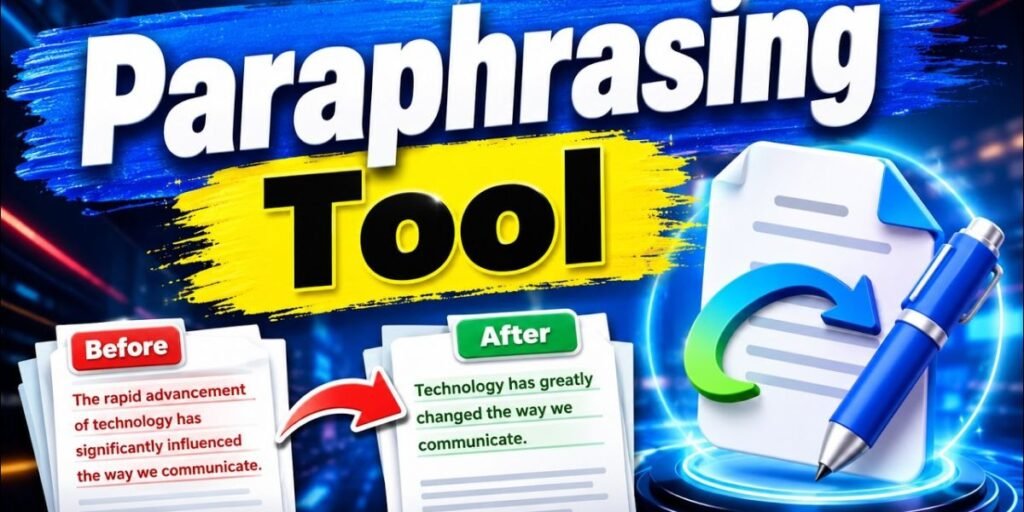
Below is an example from my testing sessions illustrating the original input, Kroolo’s automated output, and my final edited version:
- Original Passage: “The implementation of stringent regulatory oversight significantly mitigated systemic financial risk among regional banking institutions during the economic downturn.”
- Kroolo AI Output: “Enforcing strict regulatory supervision greatly reduced widespread financial danger in local banks throughout the recession.”
- My Edited Final Version: “Strict regulatory oversight significantly reduced systemic risk across regional banks during the economic recession.”
In this instance, Kroolo successfully simplified the sentence structure. However, changing systemic financial risk to widespread financial danger lost the formal technical meaning used in economics. My manual edit restored the precise academic term while keeping the improved, concise sentence structure generated by the tool.
The free web access limit of 5,000 characters per run proved sufficient for individual paragraphs and short section drafts. However, working on a 3,000-word term paper required breaking the text into four separate blocks, which added a few extra steps to the editing process.
How to Use Kroolo to Improve Academic Writing
Using an AI paraphraser productively requires treating it as a supportive editing assistant rather than an automated writer. Accepting AI output without reviewing it can introduce subtle errors and undermine the scholarly quality of your work.
To integrate Kroolo safely into your academic revision workflow:
- Select the Formal or Academic Mode: Choose a formal style setting rather than casual defaults to ensure the output maintains appropriate scholarly tone and vocabulary.
- Process One Logical Unit at a Time: Paste single paragraphs or distinct sub-sections into the input box rather than fragmented sentences. Giving the AI complete context helps it preserve the logical connections between ideas.
- Compare Output Against Source Meaning: Read the rephrased passage side-by-side with your original text. Verify that no key qualifications, research findings, or statistical nuances were altered or dropped.
- Manually Restore Discipline-Specific Terms: Scan the generated text for unnecessary synonym swaps. Re-insert required technical vocabulary, proper nouns, and precise domain terms.
- Smooth Paragraph Transitions: Read the edited passage in the context of your broader essay to ensure the tone and flow match the surrounding paragraphs.
How to Paraphrase Academic Sources Without Plagiarism
A common misconception among students is that running a copied passage through an AI paraphraser automatically makes the text original and plagiarism-free. It does not.
Plagiarism includes both verbatim copying and plagiarism of ideas. Even if an AI completely restructures a sentence, presenting another researcher’s conclusions, data, or arguments without proper attribution remains a serious academic integrity violation.
To paraphrase academic sources legitimately:
- Step 1: Read and Internalize: Read the source material until you thoroughly understand its main argument. Close the source document so you are not looking at the original sentence structure.
- Step 2: Write from Memory: Express the core idea in your own words, building the sentence structure from scratch based on how you would explain the concept to a colleague.
- Step 3: Compare and Refine: Reopen the source text and compare your draft against it. Ensure your sentence structure and phrasing are genuinely distinct, rather than just a word-for-word swap.
- Step 4: Cite the Source: Insert an appropriate in-text citation (such as APA, MLA, or Chicago style) immediately following the paraphrased idea.
True paraphrasing demonstrates that you comprehend the underlying research, whereas relying solely on automated rephrasing often leaves behind the original author’s exact sentence architecture.
How to Turn Paraphrased Text Into a Submission-Ready Academic Document
Transforming raw drafts and paraphrased passages into a polished, submission-ready document requires a systematic post-editing strategy:
- Verify Claims and Data Integrity: Cross-check every paraphrased sentence against your primary sources. Confirm that numerical figures, dates, author names, and specific research findings remain accurate.
- Utilize Grammar and Style Review Tools: After refining your text structure, run your complete draft through proofreading utilities. Kroolo provides a companion AI Grammar Checker on its platform with a 5,000-character input capacity per check. It helps catch typos, punctuation errors, and subject-verb agreement issues. Review each flagged suggestion individually rather than auto-correcting everything blindly.
- Standardize Document Conventions: Ensure consistency in spelling conventions (such as US vs. UK English), tense usage, heading hierarchies, and font formatting throughout the paper.
- Audit References and Citations: Double-check every in-text citation against your bibliography or reference list. Verify that every borrowed idea carries its corresponding citation.
- Review Institutional AI Guidelines: Confirm that your university or publisher permits the use of AI editing utilities for draft revisions, and ensure your usage complies with their specific submission policies.
Common Mistakes to Avoid When Using an AI Paraphraser for Academic Work
To maintain research quality and uphold academic standards, avoid these common pitfalls when using automated paraphrasing tools:
- Blindly Accepting AI Output: Inserting rephrased text directly into an assignment without reading it carefully often introduces awkward phrasing or incorrect word choices.
- Over-Relying on Automated Synonyms: Swapping words while retaining the original author’s exact sentence flow is considered patchwriting, a form of academic dishonesty.
- Stripping Away Essential Citations: Removing author citations after rephrasing a passage hides the origin of the research ideas.
- Repeatedly Re-Paraphrasing the Same Passage: Running a single paragraph through a paraphraser multiple times degrades sentence logic and distorts the original argument.
- Ignoring Context and Tone: Mixing informal, AI-generated phrases with formal academic prose creates an inconsistent writing style across your document.
Frequently Asked Questions
Is the Kroolo AI Paraphrasing Tool free?
Yes, Kroolo provides free access to its online AI Paraphrasing Tool, allowing users to rephrase text directly on its website.
How much text can Kroolo paraphrase at once?
The web-based paraphraser currently displays a limit of up to 5,000 characters per run.
Can Kroolo paraphrase an entire academic paper in one go?
No. Because of the 5,000-character limit (roughly 750 to 800 words per run), longer papers must be processed in individual paragraphs or shorter sections.
Which paraphrasing mode is suitable for academic writing?
Selecting a formal, professional, or academic setting works best for scholarly documents, as these modes maintain a dignified tone and sophisticated vocabulary.
Does Kroolo’s grammar checker help with proofreading?
Yes, Kroolo offers a dedicated AI Grammar Checker that scans text (up to 5,000 characters per run) to highlight spelling, punctuation, and grammatical errors before submission.
Does paraphrasing with Kroolo prevent plagiarism?
No. Automated rephrasing changes word choice and structure, but it does not make the underlying idea your own. You must still properly cite the source to avoid plagiarism.
Do paraphrased academic passages still need citations?
Yes. Every paraphrased idea, statistic, or argument taken from an outside source requires a formal in-text citation and a matching reference entry.
Can students use AI paraphrasing tools for university assignments?
Policies vary across academic institutions. Most universities permit AI tools for light grammar checking and structural editing, but prohibit automated text generation or unacknowledged rephrasing. Always check your instructor’s syllabus and institutional AI policy before submitting your work.