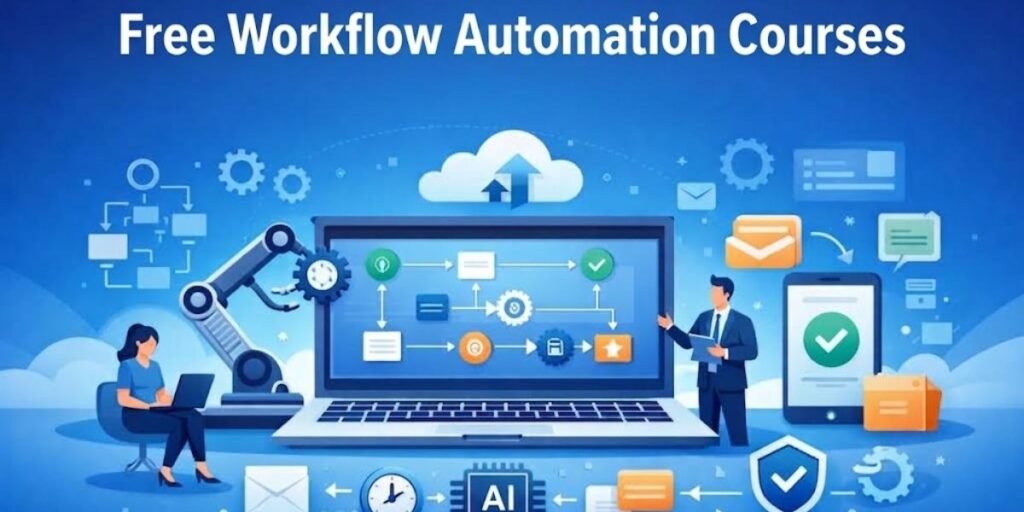
Modern workflow automation has grown far beyond simple trigger-and-response tasks. Today, building efficient digital systems means orchestrating multi-app ecosystems, managing complex API data payloads, and deploying intelligent agentic workflows that process unstructured information autonomously.
Finding structured training that bridges the gap between basic visual logic and production-ready system architecture can feel overwhelming when sorting through endless superficial video clips and paid upsells.
To help you build genuine technical competency without wasting time or money, this guide compiles the twelve best free workflow automation courses, official learning hubs, and documentation tracks available.
Every resource here has been evaluated for practical depth, instructional quality, and real-world applicability, complete with details on official certifications, skill badges, and hands-on execution.
Top 12 Free Workflow Automation Courses and Resources
1. n8n Academy
Starting an automation journey requires a platform that balances visual design with raw technical execution, and n8n Academy delivers one of the most rigorous free environments available for modern data orchestration.
The foundational modules guide learners directly through the core n8n interface, breaking down how individual nodes, event triggers, and asynchronous workflow executions interact. You learn how raw data transforms dynamically as it passes from one step to the next, establishing a solid grasp of connected workflows.
Moving past the basics, the curriculum dives deep into technical mechanics that other platforms often ignore. Learners tackle live API integrations, incoming and outgoing webhooks, authentication protocols like OAuth2, and rigorous error-testing strategies.
Completing these technical tracks provides a clear path toward professional competency. While certification policies vary by cohort, the hands-on project portfolio you build here directly translates to production-grade automation deployments.
2. Make Academy
For a deeply interactive introduction to scenario building, Make Academy stands out as an exceptional self-paced platform where all core courses are marked entirely free. Instead of relying solely on passive video watching, the environment requires learners to actively construct functional workflows inside a live workspace.
The beginner path breaks down foundational concepts such as scenarios, modules, triggers, actions, and inter-app connections. Learners quickly advance to data mapping, discovering how variables pass dynamically from source applications to destination fields without hardcoded scripts.
Instructional modules also cover crucial operational controls like routers and filters, teaching you how to split data streams and handle conditional branching logic.
As an added professional incentive, Make Academy awards verifiable Credly digital badges upon completing specific learning paths. These credentials can be shared directly to professional networks like LinkedIn to showcase verified proficiency in low-code architecture.
3. Microsoft Learn for Power Automate
Enterprise environments frequently rely on Microsoft infrastructure, making Power Automate an essential skill for corporate IT operations and business analysts. Microsoft Learn provides a massive library of free training modules tailored specifically to cloud-based process automation.
The training path begins with structural fundamentals, guiding learners through automated cloud processes, instant flows, and scheduled routines. You learn how to establish triggers, configure complex input and output parameters, and manage secure data flows across Microsoft 365 and external enterprise software.
Practical learning paths focus heavily on operational reliability. Learners are guided through the exact steps required to build, modify, test, monitor, and troubleshoot enterprise cloud flows.
The material places heavy emphasis on error-handling mechanisms and administrative monitoring dashboards, ensuring automated tasks run securely at scale.
4. Zapier Academy
Understanding the fundamental logic of event-driven software is easiest when starting with user-friendly environments. Zapier Academy provides a structured educational route focused purely on the core mechanics of app integration and trigger-action logic.
The curriculum introduces learners to essential concepts including multi-step workflows, filters, path branching, and search actions. Field mapping is taught through clear visual examples, showing how data moves from a trigger event in one application to a corresponding action in another.
Educationally, this resource shines by stripping away technical intimidation. It teaches beginners how to map out repetitive business processes as logical flowcharts before translating them into automated sequences.
Even if your long-term goals involve more advanced, self-hosted platforms, mastering the core logic taught here provides an indispensable conceptual framework.
5. Make Academy: Using AI in Make
Modern automation increasingly requires artificial intelligence to process unstructured text, documents, and media, making specialized training essential. Make offers a focused, free course exploring how machine intelligence integrates directly into automated scenarios.
The curriculum demonstrates how to incorporate AI tools into everyday workflows using specialized utilities like the Make AI Toolkit and the AI Content Extractor. Learners see firsthand how automated pipelines can ingest raw text, evaluate context, and generate structured JSON outputs.
This learning path is particularly valuable for users who already understand basic automation logic and want to expand their capabilities. It covers practical applications such as automated text classification, sentiment analysis, document data extraction, and intelligent content processing.
Completing this module contributes directly toward earning advanced platform credentials within the Make Academy ecosystem.
6. Microsoft Learn: Power Automate Desktop
While cloud flows handle web-based SaaS applications, desktop automation addresses legacy software, desktop UI interactions, and local system tasks. Microsoft offers dedicated free training focused entirely on Robotic Process Automation through Power Automate Desktop.
The learning material covers the fundamentals of desktop flows, teaching users how to record user interface actions, handle system variables, and implement conditions and loops. You learn how to automate repetitive desktop chores, interact with local file systems, and drive legacy applications that lack modern web APIs.
Choosing this resource over a cloud-centric course makes sense if your daily work involves desktop applications, spreadsheet manipulation, and local file sorting. The step-by-step modules ensure learners understand how to build resilient desktop bots that can handle unexpected window prompts and system pauses.
7. Make Academy: Introduction to Modules
When you want to understand how a specific platform operates without committing to an extensive multi-hour program, targeted micro-courses offer an efficient alternative. Make provides a focused beginner course designed to explain the fundamental building blocks of its automation environment.
Spanning a short, digestible timeframe, this module breaks down the distinct types of modules found within the platform. Learners explore the differences between actions, searches, and triggers, gaining a clear understanding of how each component initiates or modifies data movement.
This focused approach benefits beginners who want to grasp core platform architecture quickly. By isolating modules from complex scenario design, the course allows learners to master the specific mechanics of data input and output before tackling multi-step workflows.
8. Make Academy: Expanding My First Scenario
Moving beyond simple linear automations requires learning how to direct data down multiple paths based on specific criteria. This intermediate Make course serves as a direct follow-up to basic scenario building, focusing on advanced control flow mechanisms.
The curriculum centers on routers, filters, and complex conditional logic. Learners practice scheduling scenarios for automated execution and handling runtime variables using built-in tools alongside popular applications like Google Sheets.
This instructional step marks the transition from basic point-to-point connections to dynamic workflows capable of making decisions. By managing multiple output paths, learners discover how to build sophisticated automations that handle branching business logic without manual intervention.
9. Make Academy: Automation to AI Agents
As workflow design evolves toward autonomous execution, understanding the distinction between traditional scripts and intelligent agents becomes critical. Make provides a structured Foundation learning path that bridges this knowledge gap across a comprehensive series of courses and assessments.
The learning journey starts with foundational AI concepts and large language models, explaining how artificial intelligence processes natural language prompts. It then progresses into practical AI automation, examining the exact operational differences between traditional workflows, AI-assisted automations, and fully autonomous agentic systems.
This curriculum is well-suited for professionals looking to understand high-level architectural shifts. By exploring when to deploy a traditional rule-based automation versus an autonomous agent, learners gain strategic insight into modern system design and system scaling.
10. Make Academy: AI Agents in Make
Moving from conceptual understanding to practical deployment requires hands-on execution. This advanced Make course shifts focus from theory to practice, teaching learners how to plan, build, and run an active AI agent within an automated scenario.
The curriculum guides users through the structural requirements of agentic automation, including tool selection, system prompt structuring, and conversation memory management. Learners actively construct an agent, defining its operational boundaries and connecting it to external data sources.
Successfully completing this track awards the specialized AI Agent Builder badge through Credly, offering verifiable proof of advanced competency in building autonomous agentic workflows.
11. Free n8n YouTube Masterclass Course
Structured video instruction offers a dynamic way to observe experienced developers build and debug complex automations from scratch. Comprehensive community-led courses available on platforms like YouTube provide valuable deep dives into advanced tool usage.
A quality video course typically spans several hours, walking viewers through real-world deployment scenarios at an intermediate level. Instructors construct multi-step workflows from a blank canvas, demonstrating how to structure payloads, handle nested JSON data, and write custom code blocks within nodes.
These resources excel at showing the trial-and-error process of debugging live connections. Watching an instructor troubleshoot authentication errors, parse nested API responses, and refine webhook listeners provides practical insight that static documentation often misses.
12. Official Workflow Automation Documentation and API Tutorials
Once you move past beginner tutorials, official product documentation becomes one of the most reliable technical resources available. Major automation platforms maintain extensive knowledge bases filled with integration guides, API references, and step-by-step tutorials.
Official documentation from providers like Microsoft and n8n combines technical specifications with practical how-to guides and troubleshooting tips. Instead of simplified examples, these guides explain the exact behavior of connectors, rate limits, data schemas, and security protocols.
Relying on official documentation ensures you are working with up-to-date syntax and features. As platforms update their interfaces and introduce new native capabilities, consulting the primary knowledge base remains the most reliable way to maintain technical proficiency.
If you want to explore how workflow automation can be applied more specifically to content operations and agency processes, this related resource is also worth reading: