
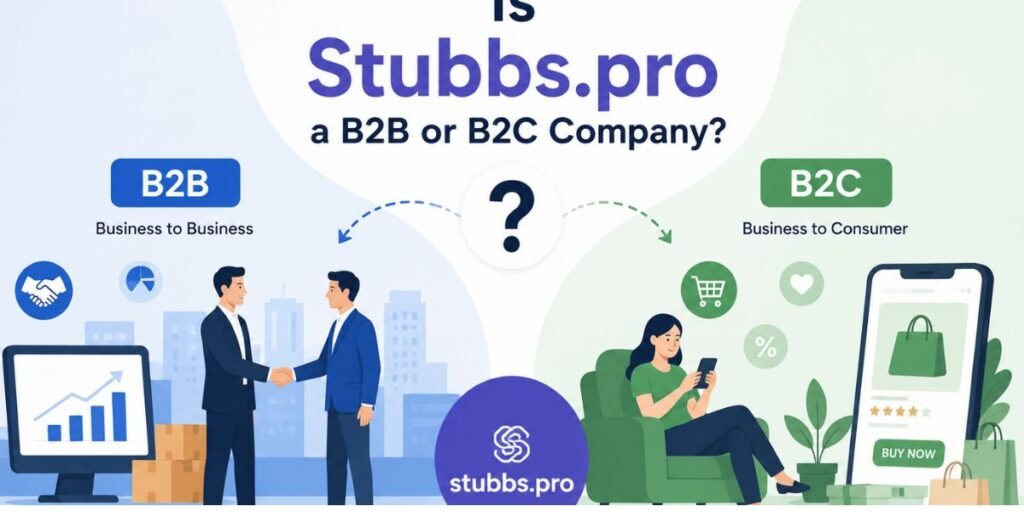
Determining the true nature of a modern technology partner requires looking past the final product to examine who pays for the service and how contracts are structured. Stubbs.pro operates as a software development firm that engineers complex digital products, many of which end users interact with daily. Because the end products are highly visible to everyday consumers, onlookers often wonder if the agency itself is a consumer-facing entity. In reality, Stubbs.pro is a business-to-business vendor that sells specialized engineering services exclusively to other corporate entities.
By analyzing the transactional mechanics, target audience, and service delivery methods of this firm, this guide clarifies the division between enterprise-level services and consumer-oriented delivery models.
What Is Stubbs.pro?
Stubbs.pro is a dedicated software engineering partner specializing in custom web and mobile application development. The firm serves as an external technical team for organizations that lack the in-house engineering capacity or specialized knowledge required to build sophisticated digital systems. Rather than selling pre-packaged software, the company offers tailored engineering services to turn custom concepts into functional code.
The service portfolio of the firm focuses heavily on high-growth and highly regulated industries where security and performance are critical. The engineering teams at the company specialize in several core areas of digital construction.
- Fintech and Banking: Building secure digital banking applications, automated payment gateways, and custom transaction processing systems.
- Web3 and Cryptocurrency: Creating decentralized exchanges, portfolio tracking applications, and smart contracts for blockchain platforms.
- Retail and E-commerce: Engineering online shopping portals, custom backend inventory tools, and integrated customer loyalty systems.
- Healthcare and Telehealth: Developing digital booking systems, secure patient portals, and HIPAA-compliant communication systems.
The clients who hire the firm are typically technology startups, mid-sized retail brands, and large enterprises requiring scalable software. Understanding the operational structure of this firm matters because it reveals how high-value technology contracts are executed in the modern digital economy. It highlights how a service company can remain entirely within the corporate sphere while building systems that eventually process millions of consumer interactions.
Understanding the Difference Between B2B and B2C
To classify any modern enterprise, we must establish a practical understanding of the two primary commercial models that dominate the digital marketplace. These models dictate how organizations market their services, structure their pricing, and manage their client relationships.
What Is a B2B Business?
A business-to-business model involves transactions where one corporate entity sells products or services directly to another commercial organization. The buyer in this scenario does not consume the service for personal entertainment or daily lifestyle needs. Instead, the buying organization uses the service to improve operational efficiency, build its own proprietary products, or scale its commercial output.
Commercial service providers operate with distinct structural characteristics.
- Longer Sales Cycles: Corporate decisions require multiple layers of approval, legal reviews, and technical assessments before a contract is signed.
- High-Value Contracts: Transactions frequently involve significant budgets, recurring monthly retainer fees, or long-term project milestones.
- Collaborative Partnerships: Service providers often integrate directly with the client’s internal teams to achieve shared business milestones.
Typical examples of this model include nearshore software development agencies, cloud infrastructure hosting providers, and corporate legal consulting firms.
What Is a B2C Business?
A business-to-consumer model focuses entirely on selling products, services, or entertainment directly to individual end users. The consumer purchases the offering to satisfy a personal need, solve an individual problem, or enjoy a retail experience.
Consumer-facing companies operate on a vastly different set of commercial principles.
- High Volume Transactions: Success depends on attracting thousands or millions of individual buyers to offset lower individual transaction values.
- Fast Decision Making: Consumers make purchasing choices rapidly based on emotional connection, convenience, brand reputation, or immediate price points.
- Transactional Relationships: Most interactions are automated, self-serve, and do not require personalized contact with a sales representative.
Familiar examples of consumer-centric companies include digital streaming services like Netflix, ride-sharing platforms, and individual fitness tracking mobile applications.
What Defines a True B2B or B2C Business?
Determining how a company is classified goes beyond looking at the interface of the software they build. Industry analysts focus on specific structural criteria to determine whether an entity belongs in the corporate-facing or consumer-facing category.
The primary indicator is the identity of the entity that pays for the service. If the revenue is generated through corporate wire transfers, enterprise service agreements, and business development contracts, the company is fundamentally corporate-facing. Conversely, if revenue arrives via individual credit card swipes, mobile app store purchases, or personal microtransactions, the company is consumer-facing.
Another critical factor is the decision-making process behind the purchase. Business purchases require executive approval, technical vetting by a Chief Technology Officer, and formal legal contracts. Consumer purchases are decided by a single person or household, usually in a matter of minutes.
The following comparative table breaks down these differences across key commercial metrics.
| Business Characteristic | Business-to-Business (B2B) | Business-to-Consumer (B2C) |
| Primary Customer | Corporate entities and startups | Individual consumers |
| Buying Process | Multi-stage review and approval | Immediate personal decision |
| Revenue Source | Enterprise service agreements | Individual retail transactions |
| Relationship | Multi-month or multi-year partnerships | Transactional or retail subscriptions |
| Typical Offering | Custom engineering and consulting | Standardized retail products |
Core Strengths of the B2B Business Model
Companies choose to operate within the corporate-facing sector because it offers several structural advantages that stabilize revenue and foster deep industry integration. These strengths are highly visible in the professional software engineering space.
One of the most notable advantages is the cultivation of long-term client relationships. Because custom software requires constant maintenance, updates, and feature additions, a development firm often secures steady work from a client for several years. This reduces the need to constantly pitch new customers to maintain operational cash flow.
The nature of corporate engagements brings several distinct benefits to the service provider.
- Higher Contract Values: A single enterprise software project can yield substantial revenue, allowing the agency to fund specialized engineering talent.
- Predictable Revenue Streams: Dedicated developer contracts and monthly team allocation models provide clear financial forecasting.
- Deep Industry Expertise: Working with specialized sectors like fintech or healthcare allows the development partner to build a reputation as a trusted domain expert.
These factors make the business-to-business framework highly resilient, particularly for specialized engineering firms that rely on close collaboration and deep technical integration.
Core Strengths of the B2C Business Model
The consumer-facing model offers a completely different set of advantages, primarily centered on scale, brand presence, and rapid market penetration.
The most prominent strength of this model is the vast size of the target market. A consumer mobile application is not limited to a small list of corporate clients. It can theoretically be downloaded and purchased by millions of individuals worldwide, allowing for exponential scaling without a proportional increase in hands-on client management.
The consumer-focused framework relies on several key operational advantages.
- Rapid Feedback Loops: High user volumes provide immediate data on feature performance, user experience issues, and feature popularity.
- Viral Brand Growth: Successful consumer applications can grow rapidly through social sharing, word-of-mouth recommendations, and app store visibility.
- Highly Scalable Assets: Once a digital consumer product is built, the marginal cost of delivering it to an additional user is extremely low.
While Stubbs.pro develops platforms that leverage these exact consumer-focused strengths, these advantages belong to the clients of Stubbs.pro rather than to the engineering firm itself. The agency acts as the engine builder, while the client operates the vehicle in the consumer marketplace.
Why Stubbs.pro Is Classified as a B2B Company
Stubbs.pro operates strictly as a business-to-business (B2B) technology vendor. The fundamental distinction lies in who pays for the services and how relationships are structured. Stubbs.pro does not retail off-the-shelf software, charging individual consumers a download fee or subscription.
The primary client base consists of startups, small-and-medium enterprises (SMEs), and larger corporate brands seeking complex digital solutions.
- Target Audience: The company targets entrepreneurs, CTOs, and product managers who require specialized engineering teams to build their products.
- Transaction Size and Contracts: Transactions are executed via corporate service level agreements (SLAs) and project-based milestones rather than immediate e-commerce shopping carts.
- Collaboration Depth: Building customized digital products requires direct integration with a client’s internal operations, aligning with typical B2B relationship-building patterns.
Read More: How to Classify a Startup: Understanding SaaS, B2B, B2C, and Modern Business Models
How Stubbs.pro’s Services Reflect This Strategy
Every core service offering in the Stubbs.pro portfolio is explicitly designed to solve operational, technical, or commercial problems for businesses, rather than lifestyle problems for individual consumers.
- Dedicated Team & CTO-as-a-Service: These models provide corporate clients with immediate access to technical leadership and scale. An individual consumer has no practical need to hire a virtual Chief Technology Officer or an entire engineering squad.
- Regulatory Compliance Frameworks: The development processes at Stubbs.pro integrate complex security standards such as HIPAA for healthcare platforms, GDPR for European data protection, and KYC/AML for fintech apps. This focus on enterprise-grade compliance directly appeals to risk-mitigation demands in corporate procurement.
- Complex Backend Integrations: Their engineers build custom CRM, ERP, and API configurations. These architectural solutions organize internal business workflows, optimize logistics, and connect corporate data points rather than acting as a standalone consumer app.
Why Some People Mistake Stubbs.pro for a B2C Company
The confusion arises because of the end-product paradox. When Stubbs.pro builds a sleek e-commerce store, a decentralized crypto trading portal, or a mobile fitness tracker, the eventual users of those apps are everyday consumers.
Because these downstream consumer-facing applications are highly visible to the public, onlookers mistakenly believe that Stubbs.pro is a B2C player. However, the agency acts as an enabler. The consumer brand owns the consumer-facing app and handles the B2C relationship, while Stubbs.pro remains behind the scenes as a B2B supplier of the underlying code.
Could Stubbs.pro Ever Operate as Both B2B and B2C?
A technology provider can shift from a pure-play B2B model into a hybrid model—often referred to as a B2B2C (Business-to-Business-to-Consumer) framework. If Stubbs.pro were to expand its current positioning, it would likely happen in one of two ways.
1. Proprietary Software-as-a-Service (SaaS)
If the engineering team identifies a recurring technical bottleneck across the 100+ custom projects they have delivered, they could package that solution into a standard tool. By selling this tool directly to individual developers (consumers) as a low-cost subscription, they would open a B2C revenue stream while maintaining their core enterprise services.
2. Micro-Products and Low-Code Templates
By creating and selling pre-built website templates, UI kits, or low-code software blocks directly to individual creators, freelance web designers, and hobbyists, the company would serve consumers on a transactional basis.
Why They Choose to Remain Predominantly B2B
According to public data and client portfolios, Stubbs.pro remains strictly focused on its core B2B identity. Operating a hybrid model requires massive shifts in marketing structure.
Instead of managing a handful of high-value corporate partnerships, a B2C wing demands customer support systems, digital ad campaigns, and retail conversion optimization. For a specialized software agency, the highest margin and operational efficiency lie in continuing to serve as a trusted technical partner to scaling companies.
Read More: Is DeltaY.xyz a B2B or B2C Company? A Look at Its Business Model
Key Indicators That Confirm Stubbs.pro Operates as a B2B Company
| Indicator | What It Shows About Stubbs.pro |
| Target Customers | High-growth startups, SMEs, and mid-market enterprises |
| Primary Services | Custom software development, dedicated team structures, and fractional CTO consulting |
| Revenue Model | Project agreements, monthly developer retainers, and enterprise milestones |
| Customer Relationships | Multimonth collaborative partnerships |
| Consumer Offerings | Zero direct-to-consumer software, retail apps, or consumer platforms |
Final Verdict
Stubbs.pro is a classic B2B software engineering firm. While the digital solutions they build often reach consumer hands, their clients, revenue model, and operational strategies are entirely built around business-to-business relationships. By avoiding the distraction of consumer retail support, the agency keeps its energy focused on deep, domain-specific technology engineering for growing organizations.
Frequently Asked Questions
Is Stubbs.pro a B2B or B2C company?
Stubbs.pro is a B2B company. They sell engineering services, custom software, and specialized staff augmentation directly to other businesses rather than individual consumers.
What services does Stubbs.pro provide?
They specialize in custom web and mobile development, CTO-as-a-Service, low-code builds, and dedicated development teams with expertise in fintech, Web3, AI integration, and healthtech.
Can a B2B software company build B2C applications?
Yes. Many B2B agencies build consumer products. While the final product is used by consumers, the contract, payment, and relationship exist solely between the two businesses.
Does developing consumer apps make a company B2C?
No. The business model is determined by who pays the bills. Since corporate clients pay Stubbs.pro to build those applications, Stubbs.pro remains a B2B service provider.
How does Stubbs.pro generate revenue?
They generate revenue through custom development contracts, dedicated developer monthly retainers, and structured project milestones with businesses.