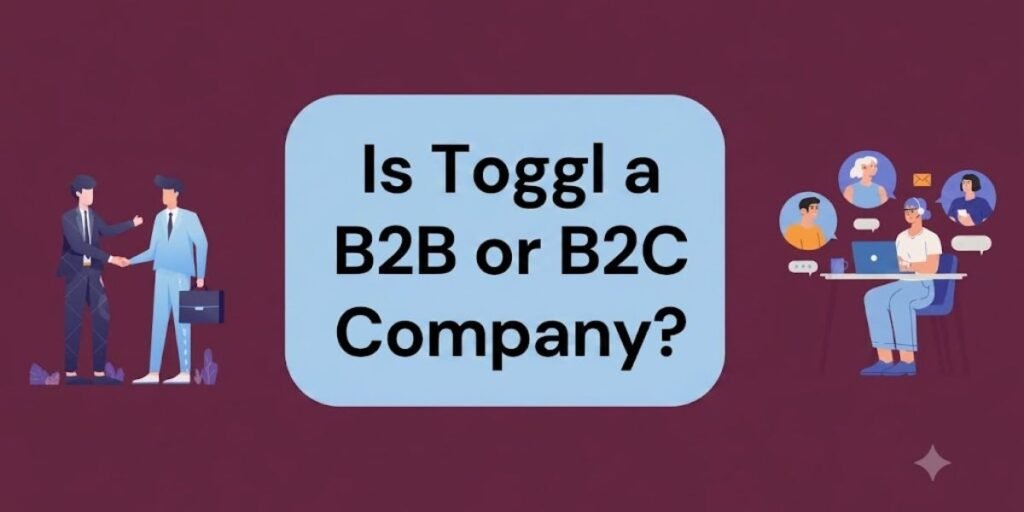
In the world of software-as-a-service, or SaaS, the line dividing businesses that serve individual consumers from those that serve corporate enterprises often looks incredibly blurry. Toggl, a highly popular suite of productivity tools famous for its simple, one-click time tracking, sits directly in the middle of this confusion. Many professionals and software analysts regularly debate the exact toggl business model b2b or b2c alignment, especially because millions of solo freelancers, students, and casual productivity enthusiasts use its clean interface daily without ever paying a single cent.
This massive base of individual users leads many to assume that the platform is a consumer-facing tool. However, a deeper look at its design, features, and core revenue generation reveals a different reality. Toggl operates fundamentally as a B2B SaaS company. While its bottom-up acquisition strategy successfully captures the consumer market, its entire product design, engineering investment, and monetization structure are built to serve teams, agencies, and growing corporate enterprises.
Is Toggl B2B or B2C?
Toggl is primarily a B2B (Business-to-Business) company. Although the platform offers a remarkably generous free tier that attracts millions of solo users, this is a strategic acquisition funnel rather than the core business model. The company generates the vast majority of its revenue by selling team-management, tracking, and resource-planning tools directly to organizations.
Individual users typically sign up for personal productivity, but they rarely transition into high-paying accounts. Instead, Toggl relies on businesses, agencies, and consulting firms that purchase multi-seat subscriptions. These corporate clients pay per user, per month to coordinate workflows, monitor employee billable hours, and analyze project margins. For Toggl, the individual user is a gateway, but the paying business is the ultimate customer.
Read More: Is Stubbs.pro a B2B or B2C Company? Understanding Its Business Model and Services
What Makes a Business B2B or B2C?
Understanding where a software company fits on the market spectrum requires moving past basic definitions. Business classification is not determined by who navigates to the website; it is defined by the specific audience the product is engineered to serve and the mechanism through which the company generates its revenue.
What Defines a B2B Business?
In a B2B model, the transaction occurs entirely between two corporate entities. The primary characteristics of a B2B business include:
- Primary Customers: The buyers are businesses, corporations, non-profits, or government agencies rather than private citizens.
- Operational Problem Solving: The software is designed to solve organizational bottlenecks, streamline team collaboration, manage payroll, or improve overall operational efficiency.
- Enterprise Procurement: Sales processes are often formal, involving department heads, IT security reviews, and multi-user procurement contracts.
- Value-Driven Pricing: Pricing models are structured around corporate value, such as cost-per-seat licensing, usage volume, or customized enterprise agreements.
Classic examples of pure B2B software companies include Salesforce, Slack, Jira, and HubSpot, all of which require corporate infrastructure to be fully utilized.
What Defines a B2C Business?
In a B2C (Business-to-Consumer) model, the relationship is established directly between the software creator and the individual end-user. The core indicators of a B2C business are:
- Individual Target Market: The marketing campaigns and user experiences are built to appeal to the personal needs, lifestyle, or entertainment of a single person.
- Personal Utility: The product helps the user manage personal finances, stream media, learn a hobby, or organize their private life.
- Simplified Buying Decisions: The purchasing decision is made instantly by a single person, typically using a personal credit card without requiring administrative approval.
- Flat Pricing Structures: Subscription models are simple and flat, often offering single-user monthly plans or family bundles.
Familiar examples of B2C digital companies include Spotify, Netflix, Duolingo, and Headspace.
Read More: How to Classify a Startup: Understanding SaaS, B2B, B2C, and Modern Business Models
The Key Criteria Used to Classify a Business Model
To accurately classify modern SaaS giants that appear to serve both markets, industry analysts use specific operational benchmarks. Simply looking at the user base is not enough. Instead, professionals evaluate a company against these clear operational questions:
- Who Pays the Bills? While many individuals use a product, we must look at who contributes the highest percentage of the company’s monthly recurring revenue.
- Who is the Development Team Building For? When engineering resources are allocated, we evaluate whether they are building personal organization tools or team-wide administrative dashboards.
- How is the Go-To-Market Strategy Structured? We analyze whether marketing campaigns target individual app stores or focus on B2B channels like LinkedIn, industry events, and procurement departments.
- How is the Pricing Structured? We check if the pricing scale is designed to expand organically as an organization grows its headcount.
These criteria provide a practical framework for determining whether Toggl operates primarily as a B2B or B2C company.
What Toggl Builds and Who It Is Designed to Serve
Over the years, Toggl has expanded far beyond a simple web-based timer. It has constructed a comprehensive product ecosystem designed to optimize team productivity and business operations. The portfolio consists of three core applications:
- Toggl Track: A time-tracking platform that allows teams to record billable hours, monitor project budgets, and generate detailed client reports.
- Toggl Plan: A visual team-scheduling tool that helps project managers allocate resources, plan timelines, and prevent employee burnout.
- Toggl Hire: A full-funnel candidate screening tool designed to help HR departments automate pre-employment skills assessments.
While a solo designer can easily use Toggl Track to see how long they spend on a logo, the actual layout of the entire ecosystem is engineered for collective team environments. The tools link together to solve complex business puzzles like resource allocation, labor cost calculation, and recruitment screening.
Evaluating Toggl Against the Characteristics of a B2B Company
Analyzing Toggl against the core benchmarks of B2B operations reveals that the platform’s financial and structural design aligns perfectly with corporate business requirements.
Its Revenue Comes Primarily from Business Subscriptions
The most definitive proof of Toggl’s B2B status lies in its cash flow. While the free tier has a cap on features, the paid tiers, Starter at $9 per user per month and Premium at $18 per user per month, are calculated on a per-seat model.
An individual freelancer rarely feels compelled to pay $108 annually just for basic reporting. However, a 50-person creative agency will happily pay $9,000 annually ($18 per user for 50 users) for the Premium plan. This per-seat pricing model ensures that Toggl’s revenue scales exponentially with organizational size rather than individual sign-ups.
The Platform Is Built Around Teams and Organizations
The interface of Toggl Track is structurally organized around workspaces, teams, and client profiles. The platform assumes that the user is part of a larger ecosystem where time data must be aggregated.
Features like shared team dashboards, locked timesheets, and administrative controls do not make sense for a solo consumer. These functions are built specifically so a department head can verify that payroll and billable hours are accurate across an entire division.
Enterprise Features Reflect Business Priorities
Toggl’s high-tier engineering efforts are dedicated entirely to enterprise-grade functionality. The platform offers advanced systems like Single Sign-On (SSO), automated timesheet approvals, and custom labor cost tracking.
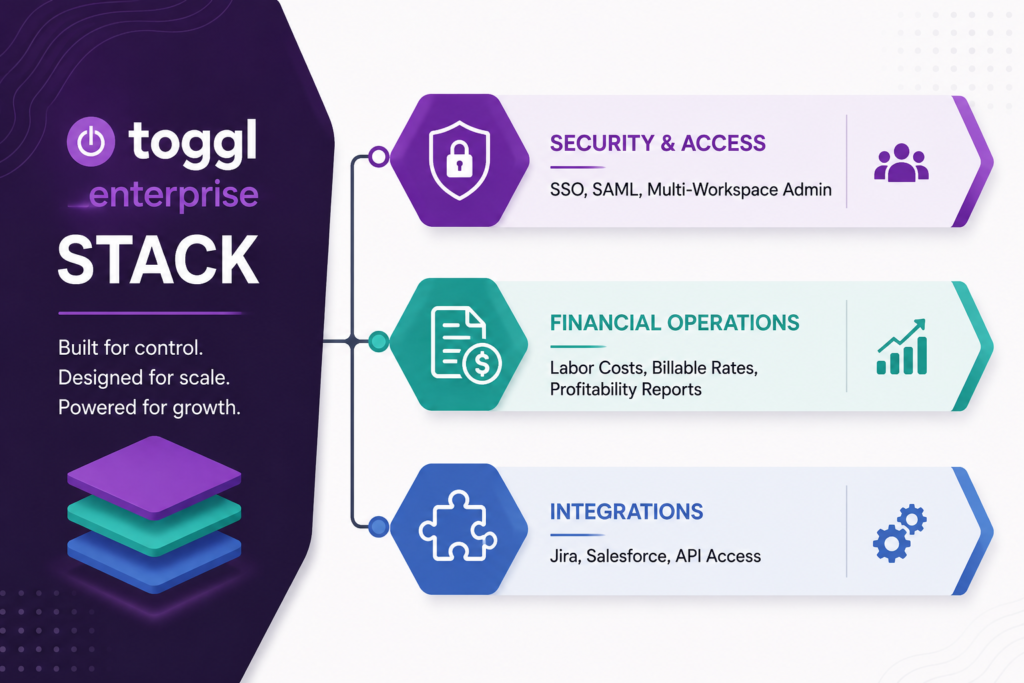
These are not tools built for personal time management. They are sophisticated, security-compliant protocols designed to satisfy corporate IT directors and financial officers who need to measure project profitability and integrate data into larger ERP systems.
Its Pricing Model Scales with Organizational Growth
Toggl does not offer a “family plan” or simple flat-rate consumer subscriptions. Instead, its pricing model is highly sensitive to corporate scale.
As a business hires more employees, its software expenses with Toggl rise automatically. This scaling mechanism is a classic B2B SaaS metric, allowing Toggl to maximize its Average Revenue Per Account (ARPA) by letting clients pay for exact usage as they grow.
Why Toggl Is Sometimes Mistaken for a B2C Platform
It is entirely understandable why many users perceive Toggl as a consumer product. The brand has made strategic decisions that closely mimic B2C user-acquisition tactics.
The Bottom-Up Freemium Trap
Toggl uses a classic Product-Led Growth (PLG) model. By offering a robust, free-forever plan for solo users, they lower the barrier to entry. This strategy serves as an highly efficient, low-cost marketing channel.
When freelancers or students use the free version, they become familiar with the product. When those freelancers join larger agencies, or when those students enter the corporate workforce, they immediately advocate for Toggl to be adopted as the company-wide tracking tool.
The individual-focused free plan is not the end product; it is a clever, self-serving distribution network designed to bypass traditional, high-cost corporate sales teams. Accessibility and ease of signup do not dictate a company’s underlying business model—the monetization strategy does.
Who Gets the Most Value from Toggl?
The organizations that extract the highest ROI from the Toggl ecosystem are those whose entire profitability depends on the precise measurement of labor hours.
- Creative and Marketing Agencies: Professional service firms use Toggl to track exact hours spent on client projects to ensure their retainers remain profitable.
Competitor Pricing Intelligence for SaaS Founders - IT and Software Consultancies: Engineering teams utilize Toggl’s integrations with tools like Jira to track actual development time against estimated sprint points.
Toggl Track - Remote and Hybrid Startups: Distributed companies rely on Toggl’s transparent dashboards to keep asynchronous teams aligned without resorting to invasive surveillance software.
- Freelance Networks: Independent consultants use the professional reporting features to provide clean, undeniable proof-of-work documents alongside their monthly invoices.
Timely
Can One Company Be Both B2B and B2C?
In modern software development, many companies adopt a hybrid business model that serves both markets. However, even within hybrid models, a company’s primary classification is determined by its strategic focus and core revenue drivers.
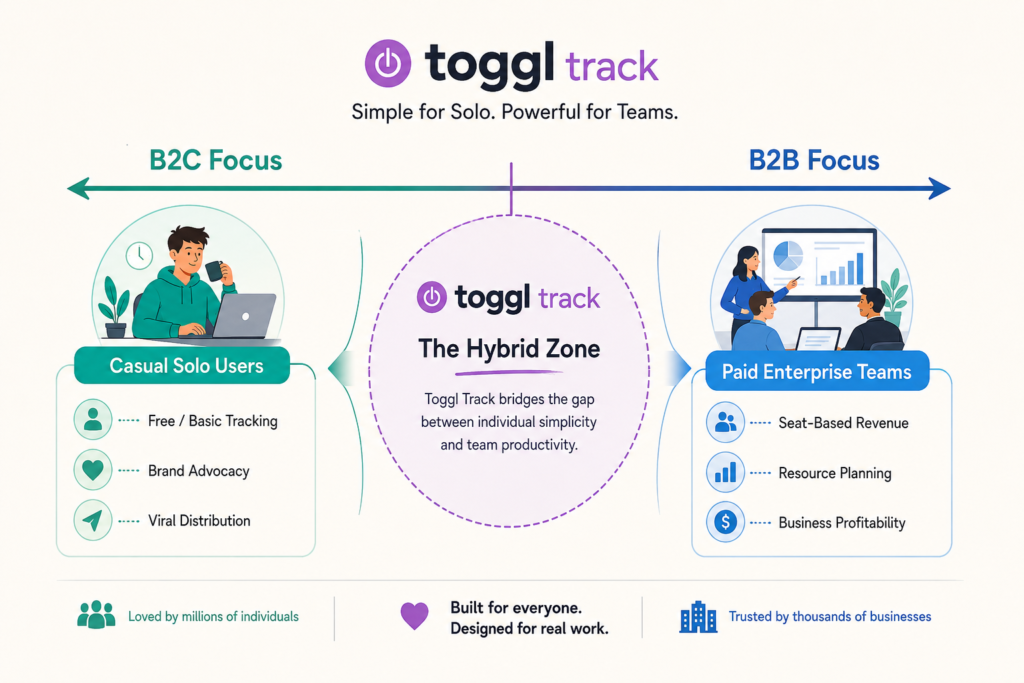
SaaS companies like Dropbox, Evernote, and Toggl began with massive consumer adoption. However, consumer subscriptions have high churn rates and low price ceilings. To build a sustainable, venture-scale business, these companies naturally pivot their product roadmaps toward corporate teams.
While individual consumers are welcomed and supported, the product’s ultimate evolution is driven entirely by the high-value contracts and security needs of corporate clients.
Final Assessment: Where Toggl Fits in the B2B–B2C Spectrum
When evaluating all variables, Toggl is a textbook B2B SaaS company operating a product-led growth model.
It leverages a consumer-friendly, friction-free interface to capture the hearts of individual users. However, it monetizes, designs, and sustains its business by solving complex organizational challenges for paying companies. The free consumer tier is a powerful marketing engine, but the paying business customer is the true foundation of Toggl’s corporate business model.
Read More: Is DeltaY.xyz a B2B or B2C Company? A Look at Its Business Model
FAQs
Is Toggl considered a B2B SaaS company?
Yes. Toggl is classified as a B2B SaaS (Software-as-a-Service) company because its product development, core marketing, and recurring revenue generation are designed around corporate clients and teams.
Why do freelancers use Toggl if it is primarily B2B?
Freelancers use Toggl because of its generous free solo tier and highly intuitive interface. This free usage benefits Toggl by building brand advocacy, creating a massive pipeline of users who eventually recommend the software when they join larger agencies or corporate teams.
Can a company be both B2B and B2C?
Yes, this is known as a hybrid business model. Many modern SaaS companies use a B2C-style freemium acquisition model to build a large user base, but maintain a B2B focus to drive their main revenue through high-value team and enterprise subscriptions.
What determines whether a company is B2B or B2C?
A company’s classification is determined by its primary source of revenue, its target audience, and the problems the software is engineered to solve. If the primary focus is on corporate administration, team workflows, and multi-seat licensing, it is B2B.
How does Toggl generate revenue?
Toggl generates revenue by charging a recurring monthly or annual fee per user seat on its paid plans. While individual basic accounts are free, companies pay a premium rate for every employee added to their shared workspace.
Who are Toggl’s primary customers?
Toggl’s primary paying customers are professional service agencies, consultancies, design studios, software development firms, and remote businesses that need to track billable hours, manage team capacities, and monitor project margins.