
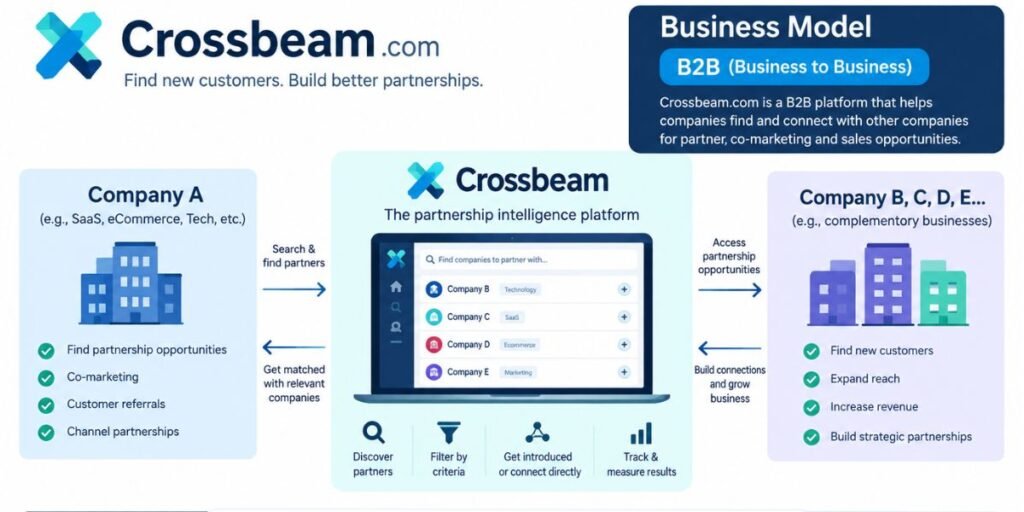
Crossbeam operates entirely as a B2B SaaS enterprise software company, focusing exclusively on the business market rather than engaging with individual consumers or retail buyers.
The platform delivers cloud-based software subscriptions to organizations that need to leverage their strategic partner networks, shared account records, and proprietary ecosystem data to uncover new sales and revenue opportunities.
Rather than serving individual end users, the software targets corporate go-to-market teams, business development units, and revenue operations leaders.
The core commercial objective of the enterprise centers on defining what the software sells, identifying who pays for the licensing agreements, explaining how the underlying technology generates measurable business value, and examining what historical financial records reveal about its commercial growth.
What Is Crossbeam.com?
| Detail | Information |
| Company | Crossbeam |
| Founded | 2018 |
| Headquarters | Philadelphia, Pennsylvania |
| Business Model | B2B SaaS |
| Product Category | Ecosystem revenue / partner ecosystem software |
| Primary Customers | Businesses |
| Core Areas | Account mapping, partner data, co-selling, ecosystem revenue |
| Company Status | Private |
Founded in 2018 and headquartered in Philadelphia, Pennsylvania, Crossbeam was built to solve a notoriously inefficient operational bottleneck in corporate sales: how software companies and service providers can discover overlapping customer accounts with their strategic partners without compromising data privacy or exposing sensitive client lists.
In the early days of modern tech partnerships, business development teams relied on manual spreadsheet exchanges, static CSV file uploads, and insecure email threads to compare customer pipelines.
The platform pioneered the concept of automated account mapping and evolved into the market’s premier ecosystem revenue platform, helping organizations treat partner networks as structured, data-driven revenue engines rather than casual networking channels.
Today, the software serves over 30,000 companies, ranging from agile mid-market technology vendors to massive enterprise software providers, integrating directly into everyday corporate infrastructure like Salesforce and Slack.
How Crossbeam’s Business Model Works
The commercial engine behind Crossbeam is structured around enterprise subscription agreements where corporate entities pay recurring software licensing fees to access a secure, cloud-based data collaboration network. Rather than relying on transactional per-lead fees or consumer advertising, the company monetizes its platform through tiered software tiers based on organizational usage, data volume, and the complexity of integrations required by enterprise buyers.
At its core, the business model turns dormant partnership networks into active, measurable revenue channels by solving a critical trust dilemma in modern go-to-market strategy.
When two software companies want to collaborate, they each possess proprietary customer and prospect data inside their respective customer relationship management systems that they cannot legally or safely share in raw form.
The platform bridges this gap by acting as a zero-knowledge data escrow service, allowing businesses to connect their CRM data sources and securely compute exact mathematical overlaps without ever exposing non-overlapping records or sensitive client identities to their partners.
This enables partnership and sales teams to pinpoint shared accounts instantly, coordinate co-selling motions, and track partner-sourced pipeline contribution from initial contact all the way through closed-won enterprise revenue.
The buyers of this technology are corporate entities rather than individual users, though the platform is utilized daily by specialized internal stakeholders including partnership teams, sales representatives, revenue operations managers, marketing specialists, and executive leadership.
By tying ecosystem intelligence directly into core revenue systems like Salesforce, HubSpot, and Slack, the platform transforms partnerships from an unmeasured branding exercise into a predictable science.
Companies willingly pay substantial annual software fees because the system accelerates sales cycles, uncovers warm referral pathways within existing partner networks, and provides transparent attribution metrics that prove the direct financial return on ecosystem investments.
Crossbeam — the Ecosystem Revenue Platform for GTM teams
This video provides an inside look at how modern go-to-market teams use ecosystem-led growth strategies and secure account mapping on the platform.
Who Pays for Crossbeam?
Understanding the commercial structure of Crossbeam requires looking closely at the fundamental difference between who uses the software on a daily basis and who actually authorizes the budget to pay for it.
The software is purchased exclusively by corporate entities through annual or multi-year enterprise subscription contracts, meaning the ultimate buyer is the business organization rather than an independent professional.
However, the platform is actively deployed across multiple internal functional units that rely on partnership data to drive commercial growth.
Partnership and channel teams utilize the software to manage existing alliances, discover new partnership opportunities, and track the overall health of their ecosystem networks.
Sales organizations and account executives leverage the platform to identify warm introduction pathways, uncovering active deals where a trusted partner already has an established relationship with the target prospect.
Revenue operations and marketing teams depend on the system for clean data hygiene, attribution modeling, and pipeline analytics to measure how partner-driven campaigns contribute to overall top-line growth.
Executive leadership and ecosystem revenue leaders view the platform as a strategic asset that transforms informal business relationships into quantifiable, predictable revenue streams, justifying the software expenditure across the entire go-to-market organization.
How Crossbeam Makes Money
The monetization strategy of Crossbeam is built squarely on a recurring software-as-a-service model, where enterprises pay subscription fees for continuous access to the cloud platform, advanced data integrations, and ecosystem analytics tools.
While private software companies typically do not publish granular pricing tiers or exact per-seat figures, the commercial structure relies on scaling tiers determined by organizational size, data volume, the number of connected partner relationships, and the depth of CRM integrations required.
The underlying financial value delivered to these enterprise buyers stems directly from sales efficiency and pipeline acceleration.
When sales teams can instantly identify shared accounts across hundreds of partner networks without manual spreadsheet coordination, sales cycles shorten and win rates climb.
By integrating deeply into core infrastructure like Salesforce and HubSpot, the platform embeds itself into daily commercial workflows, making it a sticky, mission-critical operational tool for modern tech companies.
It is important to separate actual operating revenue generated from commercial software sales from the venture capital funding rounds raised by the company.
Substantial venture backing reflects strong investor confidence and capital deployed for product expansion, but it represents external financing rather than organic sales revenue generated from customer subscriptions.
Crossbeam Revenue History
As a privately held enterprise software company, Crossbeam is not legally required to publish detailed quarterly earnings statements or exact annual recurring revenue figures.
However, public corporate data providers and technology market reports offer verified estimates regarding the company’s financial growth trajectory during key periods of expansion.
| Period | Revenue Information | Context |
| 2021 | Approximately $10.2 million | Estimated annual revenue reported by third-party company intelligence databases during rapid market expansion |
| Later Years | Current figures not publicly disclosed | Privately held status exempts the company from mandatory public financial disclosures |
To evaluate the business accurately, financial analysts and industry observers must maintain a clear distinction between three separate economic metrics that are frequently blurred in software discussions:
- Revenue: Actual cash and subscription billings generated directly from enterprise customers purchasing software licenses.
- Funding: External capital invested into the company by venture capital firms and institutional investors to fuel research, development, and market growth.
- Valuation: The estimated total financial worth of the private company determined during institutional funding transactions based on projected growth and market share.
Understanding these boundaries ensures a realistic assessment of the business model, separating investor capital from genuine commercial sales performance.
Crossbeam’s Funding and Growth History
The commercial trajectory of Crossbeam is closely tied to aggressive venture capital backing from prominent institutional investors who recognized the rising market demand for ecosystem-led growth software.
The company’s funding history illustrates how strategic capital injections fueled its evolution from a basic account mapping tool into a comprehensive enterprise platform:
- Seed and Early Growth: Initial capital rounds established the foundational technology, enabling the engineering team to build secure, zero-knowledge data sharing protocols that satisfied strict corporate security requirements.
- Series B and C Financing: Major institutional rounds, including significant investments led by firms like Sequoia Capital, Meritech Capital Partners, and FirstMark Capital, provided tens of millions of dollars to scale go-to-market operations, expand enterprise sales teams, and build native integrations for major CRM platforms.
- Platform Expansion: Subsequent capital enabled the development of advanced automated features, artificial intelligence capabilities, and deeper attribution tools designed to help large enterprises measure the exact financial ROI of their partnership ecosystems.
Rather than serving as a mere chronological list of press releases, this funding progression highlights how outside capital was deployed strategically to build out complex data infrastructure, secure enterprise trust, and capture dominant market share in the emerging ecosystem revenue category.
What Companies Use Crossbeam For
Account Mapping With Partners
Organizations leverage the platform to eliminate the traditional friction of manual pipeline comparison. Instead of exchanging static spreadsheets or relying on insecure email attachments, companies connect their customer relationship management systems directly to the secure cloud environment.
The software automatically cross-references records with chosen business partners, identifying exact overlaps among prospects, active leads, and existing clients without exposing unapproved customer data.
This automated account mapping allows partnership teams to establish clear visibility into shared market reach within seconds.
Partner-Sourced Pipeline
Discovering hidden sales opportunities within an existing network represents a primary commercial driver for enterprise adoption.
When sales pipelines are synchronized against partner databases, companies can instantly detect when a target prospect is already a customer or active evaluation lead for a trusted alliance partner.
This visibility uncovers high-value, warm introduction pathways that bypass standard cold outreach, significantly increasing conversion rates and driving high-quality, partner-sourced pipeline growth.
Co-Selling
Co-selling requires tight operational coordination between independent sales organizations, which historically suffered from communication gaps and misaligned timing.
The platform bridges this gap by enabling sales teams to collaborate directly around verified account overlaps in real time.
Account executives can view mutual partner relationships inside their native CRM interfaces, coordinate joint outreach strategies, share deal status updates, and align closing motions to present a unified front to major enterprise prospects.
Partner Ecosystem Intelligence
Managing an extensive partner network requires more than tracking casual introductions; it demands deep operational analytics.
The platform provides comprehensive ecosystem intelligence that helps revenue leaders evaluate which partnerships actually generate commercial momentum.
By tracking engagement frequency, account overlap density, and active deal progression across different alliances, organizations can identify high-performing partners, optimize resource allocation, and restructure or phase out inactive alliances based on hard data.
Revenue Attribution
Partnership programs have historically struggled to prove their exact financial return on investment to executive leadership, often treated as unmeasured brand channels rather than core revenue drivers.
The platform solves this attribution challenge by connecting ecosystem activity directly to closed-won deals and revenue metrics inside enterprise CRMs.
Revenue operations teams can accurately measure how partner-sourced and partner-influenced opportunities contribute to quarterly bookings, justifying partnership budgets with verifiable financial proof.
Is Crossbeam.com a B2B or B2C Business?
Evaluating the structural characteristics of Crossbeam confirms that it operates exclusively as a B2B enterprise SaaS business.
The customer paying for the software is invariably a business organization, the software architecture is engineered specifically for organizational use and data security compliance, and the primary users are corporate professionals operating within specific functional departments.
The product relies entirely on corporate data streams, commercial integrations, and partner relationships designed to accelerate business-to-business growth.
This stands in stark contrast to a conventional business-to-consumer model, where individual retail shoppers purchase products or services for personal use, household utility, or individual entertainment.
Because every core element of the platform serves corporate expansion, sales operations, and partnership management, its classification as a B2B software company is definitive.
If you want to explore how other companies operate and whether their business models are B2B or B2C, these articles offer further insights:
- B2B or B2C? RenovatlyGrowth.com Business Model Explained
- WGG (WGG Advertising Agency) Business Model: B2B or B2C? A Fact-Based Explanation
Crossbeam’s Position in the B2B SaaS Market
Within the broader software landscape, Crossbeam occupies a distinct leadership position at the intersection of B2B SaaS, partner ecosystem software, and ecosystem-led growth.
While traditional customer relationship management software focuses strictly on managing a company’s internal sales pipeline and proprietary client records, this platform pioneeringly shifts focus outward, enabling secure inter-company collaboration.
By treating partnership data as a collaborative asset rather than a siloed internal record, the company created an entirely new software category centered on account mapping, partner intelligence, and revenue operations.
This market positioning allows tech companies to build interconnected go-to-market motions that traditional standalone CRMs cannot support on their own, cementing the platform as a foundational layer in modern revenue tech stacks.
Key Facts About Crossbeam
| Detail | Information |
| Company | Crossbeam |
| Founded | 2018 |
| Headquarters | Philadelphia, Pennsylvania |
| Business Model | B2B SaaS |
| Product Category | Ecosystem revenue / partner ecosystem software |
| Primary Customers | Businesses |
| Core Areas | Account mapping, partner data, co-selling, ecosystem revenue |
| Company Status | Private |
Frequently Asked Questions About Crossbeam
Is Crossbeam a B2B or B2C Company?
Crossbeam is strictly a B2B enterprise software company. It sells subscription software exclusively to business organizations rather than individual consumers.
What Does Crossbeam.com Do?
The platform serves as an ecosystem revenue platform, enabling businesses to securely map overlapping accounts with strategic partners, identify sales opportunities, and coordinate co-selling motions without exposing sensitive client data.
How Does Crossbeam Make Money?
The company generates revenue through a recurring software-as-a-service subscription model, charging corporate enterprises tiered software licensing fees based on usage, data volume, and integration complexity.
Who Uses Crossbeam?
The platform is utilized by corporate professionals across partnership teams, sales organizations, revenue operations, marketing departments, channel management, and executive leadership.
How Much Revenue Does Crossbeam Generate?
As a privately held company, Crossbeam is not required to publish official annual revenue figures, though third-party market reports historically estimated milestones during rapid scaling phases.
Is Crossbeam a SaaS Company?
Yes. The platform is delivered entirely as a cloud-based software-as-a-service solution integrated directly with enterprise CRM systems like Salesforce and HubSpot.
When Was Crossbeam Founded?
The company was founded in 2018 in Philadelphia, Pennsylvania.
Who Are Crossbeam’s Customers?
The platform serves over 30,000 corporate customers, ranging from agile mid-market technology vendors to large enterprise software providers operating within global B2B markets.