Modern enterprise software environments have shifted from centralized on-premise stacks to sprawling ecosystems of cloud-based applications. Large organizations no longer rely on a handful of applications controlled entirely by a central IT department. Instead they operate using hundreds or even thousands of SaaS products distributed across global teams, remote workers, and various subsidiaries.
This transition has introduced a significant operational blind spot. Many enterprises currently struggle to identify exactly which software tools they own, who is accessing them, and whether the spending matches the actual utility of the product. This lack of visibility does not just impact the bottom line. It introduces substantial security and compliance risks that traditional management methods are unequipped to handle.
In the current landscape SaaS software asset management has matured into a critical discipline. It is no longer a simple bookkeeping task managed on a spreadsheet. High-growth organizations now integrate this practice into their core security governance, financial operations, and identity management frameworks.
Without a dedicated strategy, unmanaged SaaS growth leads to severe exposure. Large companies often find they are paying for duplicate subscriptions across different departments or maintaining unused enterprise licenses that cost millions in wasted annual spend. Furthermore the rise of unauthorized AI tools and shadow IT means corporate data is frequently flowing through applications that have never undergone a security review.
What Is SaaS Software Asset Management?
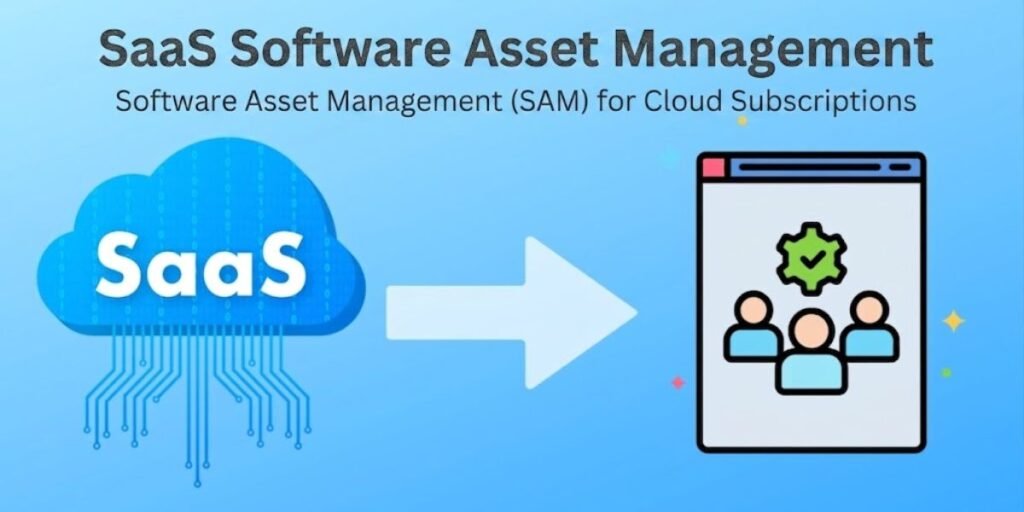
SaaS software asset management (SaaS SAM) is the comprehensive process of discovering, governing, and optimizing cloud-based software subscriptions within an organization. While traditional enterprise asset management software focused on physical hardware or static perpetual licenses, SaaS SAM is designed for the fluid, subscription-based nature of the modern cloud.
This discipline provides a centralized layer of truth for tools that are often bought in a decentralized manner. In a large enterprise procurement is no longer a bottleneck. A marketing manager can buy an analytics tool with a corporate credit card or a developer can sign up for a new platform using OAuth via their work email.
The primary goal is to ensure the organization has total visibility into the software lifecycle. This includes knowing who owns the relationship with the vendor, the frequency of user engagement, and the specific security permissions granted to each application.
The scope of management covers essential enterprise staples such as:
- Collaboration tools like Slack, Zoom, and Microsoft 365.
- Customer and HR platforms such as Salesforce, Workday, and HubSpot.
- Development and creative suites including GitHub, Atlassian, and Adobe Creative Cloud.
Why SaaS Asset Management Became Critical in Large Enterprises
The rapid acceleration of digital transformation has made traditional software management obsolete. In the past software was installed locally and IT teams held the keys to all installations. Today the perimeter has vanished as employees subscribe to tools instantly from any location.
Large enterprises now commonly manage between 300 and 1,500 distinct SaaS applications. This scale makes manual tracking impossible. Without specialized saas spend management tools organizations lose the ability to forecast budgets or negotiate effectively with vendors who often bake auto-renewal clauses and price escalations into their contracts.
The decentralized nature of SaaS means that software sprawl happens silently. Overlapping functionality is a common result where different departments might be paying for three different project management tools simply because there is no cross-functional visibility.
The Real Enterprise Problem: Shadow IT
Shadow IT is perhaps the most significant driver for the adoption of saas asset management solutions. It refers to any application or cloud service used by employees without formal approval from the IT or security departments.
The danger here is rarely about the monthly subscription cost. The true risk lies in data exposure and compliance violations. When an employee connects a third-party AI plugin to a corporate CRM or uploads sensitive financial data to an unapproved cloud storage site they bypass the organization’s security controls.
Enterprises in highly regulated sectors like finance and healthcare treat shadow IT as a primary cybersecurity threat. These organizations use management platforms to detect:
- Risky OAuth integrations where apps request excessive permissions to read corporate emails or files.
- Inactive accounts that remain open after an employee has left the company.
- Unapproved generative AI tools that may be training their models on proprietary corporate data.
By regaining control over shadow IT, IT leaders can move toward a zero-trust security model. This ensures that every application connected to the corporate network is accounted for and vetted.
How Enterprise SaaS Asset Management Platforms Work
Modern software asset management platforms function by creating an automated web of integrations across the existing corporate infrastructure. They do not rely on manual data entry. Instead they pull live data from the systems where software activity actually occurs.
These platforms typically sync with:
- Identity Providers (SSO): Tools like Okta or Microsoft Entra ID to see which apps users are logging into.
- Financial Systems: Integration with Netsuite, SAP, or Coupa to track every dollar spent on software vendors.
- Browser Extensions: Monitoring browser activity to find apps that do not use SSO.
- HR Systems: Connecting to Workday to automate the deprovisioning of software when an employee is offboarded.
Core Features of Enterprise SaaS Asset Management Software
To manage a modern environment, these platforms offer specific modules tailored to different operational needs.
SaaS Discovery
The discovery engine is the foundation. It uses various methods, including financial forensics and endpoint monitoring, to map out the entire software estate. This includes identifying freemium tools that may not yet appear on a credit card statement but are already being used to process corporate information.
License Optimization
Optimization is where the immediate ROI is found. Large organizations often discover that 20% to 30% of their licenses are either unused or underutilized. Platforms analyze login frequency and feature usage to suggest where seats can be reclaimed or where a user can be downgraded from a Pro to a Basic tier.
Renewal Management
Renewals are a major source of financial leakage. Most enterprise SaaS contracts are designed to auto-renew unless canceled within a specific window.
Software asset management platforms provide:
- Automated renewal calendars to alert procurement teams months in advance.
- Vendor benchmarking data to show what other companies are paying for the same service.
- Utilization reports to provide leverage during price negotiations.
Identity and Access Governance
This feature focuses on the who of the software equation. It identifies orphaned accounts which are licenses still assigned to former employees. It also monitors administrative privileges to ensure no single user has unnecessary levels of access. This is essential for maintaining compliance with standards like SOC 2, GDPR, or HIPAA.
SaaS Spend Management in Enterprise Finance Operations
SaaS costs have evolved into one of the most volatile and fastest-growing lines on the enterprise balance sheet. In many large organizations, the total annual spend on cloud subscriptions now rivals traditional infrastructure costs. These expenses often reach tens of millions of dollars distributed across hundreds of unique vendors.
This financial complexity has led to the rise of specialized saas spend management tools designed for CFOs and procurement leaders. These tools move beyond simple accounting by providing deep granular visibility into spend velocity and vendor concentration.
Finance teams use these insights to address several critical areas:
- Cost Forecasting: Predicting future spend based on headcount growth and historical expansion rates.
- Redundancy Elimination: Identifying where the organization is paying for multiple tools that serve the same purpose, such as having active contracts for both Zoom and Microsoft Teams.
- Budget Accountability: Mapping software spend back to specific cost centers to ensure department heads are responsible for their own software footprint.
The modern standard is the FinOps model. In this framework, finance, IT, and procurement collaborate to ensure that every dollar spent on SaaS delivers measurable business value. This cross-functional approach prevents budget creep and ensures that price escalations during renewals are caught before they impact the bottom line.
Enterprise Security Risks Linked to SaaS Sprawl
While the financial implications of unmanaged SaaS are significant, the security risks are often more dangerous. SaaS sprawl creates a fragmented surface area that is difficult for centralized security teams to monitor. Each unvetted application represents a potential door into the corporate network.
Excessive OAuth Permissions
A major point of failure is the use of OAuth for social sign-on. Employees often authorize third-party apps to access their corporate accounts without realizing they are granting permission to read, delete, or share sensitive emails and files. SaaS asset management solutions monitor these scopes and alert security teams when an app requests excessive or risky permissions.
Former Employee Access
One of the most persistent security gaps in large enterprises is the failure to properly deprovision access. When an employee leaves their SSO access might be revoked but they may still have direct login credentials to niche SaaS tools. These are tools that were not integrated with the central identity provider. This creates a massive risk for data theft or insider threats.
AI Tool Governance
The explosion of generative AI has introduced a new layer of complexity. Employees are increasingly using AI-driven SaaS for drafting documents, coding, or data analysis. Without a management platform organizations cannot track which sensitive datasets are being uploaded to external AI models. They also cannot see which AI plugins have been integrated into core communication suites like Slack or Google Workspace.
How Large Enterprises Build SaaS Governance Programs
Establishing a mature governance program requires a shift from a gatekeeper mentality to a collaborative framework. Successful enterprises treat SaaS management as a shared responsibility across multiple departments. Each brings a unique perspective to the lifecycle of an application.
- IT Operations: Handles the technical discovery and the automation of the onboarding and offboarding workflows.
- Security Teams: Focus on vendor risk assessments and ensuring that all apps comply with the organization’s encryption and data residency standards.
- Procurement: Manages the commercial relationship to ensure that contracts are optimized and that the organization is not over-committing to seat counts.
- Legal and Compliance: Reviews Data Processing Agreements and ensures that SaaS usage aligns with regulatory frameworks like GDPR or CCPA.
This multi-departmental approach ensures that software is not just bought and forgotten. It is actively managed from the day it is requested until the day it is retired.
Enterprise SaaS Management KPIs That Actually Matter
To move from reactive management to a proactive strategy enterprises must track specific metrics. These reflect the health of the software ecosystem. Simply looking at the total bill is not enough to drive operational efficiency.
Key operational KPIs include:
- Utilization Rate: The percentage of assigned licenses that are actually being used by employees.
- Shadow IT Discovery Rate: The ratio of newly discovered unauthorized apps compared to the total approved catalog.
- Provisioning Accuracy: How quickly access is granted to new hires and how quickly it is revoked for departing employees.
- Renewal Savings: The total dollar amount saved through negotiation and license reclamation during the renewal window.
Common Mistakes Enterprises Make
Even with the right tools many organizations fail to achieve full control because of fundamental strategy errors. One frequent mistake is treating SaaS management as a one-time project. Software environments change daily as new employees join and teams trial new tools. Effective governance must be a continuous automated process.
Another error is ignoring small purchases. A 15-dollar-per-month subscription for a single user might seem negligible. However when multiplied by hundreds of employees across a global organization these micro-SaaS tools aggregate into a massive unmanaged expense and security liability.
Final Thoughts
For the modern enterprise the answer to what is asset management is the ability to maintain visibility and control in a decentralized environment. As organizations continue to scale their use of cloud infrastructure and AI tools the complexity of the SaaS ecosystem will only grow.
Those that invest in robust SaaS software asset management strategies will save millions in wasted spend. They will also build a more resilient and secure foundation for their digital operations.
FAQs
What is SaaS software asset management?
It is the centralized process of discovering, securing, and optimizing the cloud-based software applications used throughout an organization.
Why is SaaS asset management important for large companies?
It prevents wasted spending on duplicate or unused licenses and identifies security risks associated with unauthorized software.
What is shadow IT in a SaaS context?
Shadow IT occurs when employees use software or cloud services for work purposes without the knowledge or approval of the IT department.
How do SaaS spend management tools help finance teams?
They provide real-time data on vendor costs and usage trends allowing for better budgeting and stronger negotiation leverage.
Who is responsible for SaaS asset management in an enterprise?
It is a cross-functional effort involving IT, Security, Finance, and Procurement teams.