

The commercial viability of a modern cloud software vendor depends on operational distribution and unit economic efficiency. While private venture funding into US software ecosystems remains highly selective, private market data indicates that top-quartile SaaS enterprises still achieve growth rates exceeding 40% to 100% year-over-year by mastering efficient scale.
Building functional software features no longer establishes a defensible competitive moat. Because cloud infrastructure and artificial intelligence development frameworks have lowered technical creation barriers, sustained revenue belongs exclusively to operating teams that control customer acquisition costs (CAC) through precise market positioning, immediate product activation, and usage-driven contract expansion.
Software ventures that fail to cross the bridge from initial launch traction to predictable financial scaling usually collapse because of loose audience segmentation and inefficient capital allocation. Longitudinal software performance metrics indicate that top-tier United States business software providers achieve premium enterprise valuations—often commanding revenue multiples above 10x to 15x—by treating their product interfaces as self-service conversion engines. They configure their software environments to capture low-friction user footprints before deploying automated account expansion mechanisms or corporate sales teams to optimize net revenue retention (NRR).
In this comprehensive guide, we analyze a curated list of saas companies operating across the American ecosystem that scaled at unprecedented rates. By evaluating their internal revenue structures, private funding milestones, and acquisition frameworks, founders can learn how to build resilient, high-retention enterprise platforms.
Why Certain SaaS Companies Scale Faster Than Others
Strategic acceleration in the business software market requires a product architecture that integrates cleanly into existing corporate budgets and daily workflows. Early-stage attrition among technology startups is rarely caused by database failures or processing latency. The primary driver of corporate failure is funnel contamination, which occurs when marketing programs prioritize raw trial signup velocity over ideal customer profile alignment.
When a software business targets an unsegmented audience, its operational efficiency degrades across all core divisions. Customer support overhead expands disproportionately because non-core users require high-touch assistance for use cases outside the primary scope of the platform architecture. Simultaneously, engineering resource allocation becomes unoptimized as developers receive contradictory product feedback from low-intent users, dragging down product development velocity.
Experienced operators build fast-scaling enterprises by isolating narrow user segments that face active operational failures so severe that budget lines have already been allocated to eliminate the friction. These high-performing software platforms share specific operational patterns that stabilize unit economics during market expansions and macroeconomic contractions.
To validate your scaling potential, ensure your platform hits these key performance indicators:
- The software fixes systemic financial leakage, manual resource overallocation, or data security exposures.
- The product interface reduces time-to-first-value to under ten minutes during the initial user session.
- The monetization framework scales revenue automatically based on volume metrics, storage usage, or seat count.
- The application serves as a primary database, communication hub, or integration layer.
- The client acquisition pipeline relies on measurable programmatic channels rather than arbitrary marketing spending.
- The net revenue retention rate remains consistently above 110% through natural account expansion.
The SaaS Growth Models Dominating the U.S. Market
Selecting a distribution framework governs the corporate organizational design, engineering roadmap, and capital expenditure requirements of a software enterprise. Software operators evaluate three primary market motions to guide their customer acquisition and retention strategies.
Product-Led Growth (PLG)
The product-led growth model positions the software application as the primary vehicle for customer acquisition, user activation, and account expansion. Users initiate platform access independently through automated self-service configuration pipelines without requiring human sales interaction.
This operational framework requires a low-friction onboarding design where an individual contributor can derive standalone value without waiting for department-wide corporate adoption. Developers, digital marketers, and project managers frequently adopt software through this motion, utilizing freemium or free-trial tiers to validate system capabilities before initiating credit card payments.
Sales-Led SaaS
The sales-led distribution model relies on outbound account executives, enterprise business development representatives, and solutions engineers to navigate complex corporate hierarchies. This high-touch methodology is mandatory when the software architecture handles highly regulated corporate data, interfaces with core financial ledgers, or introduces technical infrastructure risks.
Transactions within this space involve multi-month procurement cycles, rigorous information security audits, custom data processing agreements, and formal service level agreements. Contract values are substantial, typically requiring formal authorization from chief information officers, procurement divisions, and corporate legal teams.
Hybrid SaaS Models
The hybrid conversion framework combines the broad customer acquisition reach of self-service onboarding with the high-contract monetization of enterprise sales. Individual users or isolated corporate divisions access the software application autonomously to solve immediate task-level issues.
The data layer continuously monitors workspace usage metrics, data consumption volumes, and team invitation velocity within these free or low-tier accounts. When a workspace crosses specific operational thresholds, the account is programmatically routed to an enterprise sales representative who pitches a sitewide corporate license to executive leadership.
High-Growth SaaS Companies and the Strategies Behind Their Expansion
1. Notion
What They Built
Notion Labs Incorporated developed a unified, highly customizable workspace application that consolidates document creation, relational databases, knowledge management, and task tracking inside a single interface.
Financial Track and Investment Data
Founded in San Francisco, Notion avoided early institutional venture capital rounds by maintaining a lean engineering team of fewer than ten people during its initial product iterations. In April 2020, the company secured a $50 million investment round led by Index Ventures at a valuation of $2 billion to fund structural infrastructure expansions.
By September 2021, Notion closed a $275 million Series C funding round co-led by Coatue Management and Sequoia Capital, lifting its private market valuation to $10 billion. The company maintains strong gross profit margins exceeding 85% by utilizing scalable cloud hosting infrastructure and minimizing direct implementation support costs.
Growth Strategy and Distribution Channels
Notion accelerated its market distribution by leveraging community-driven growth and user-generated template ecosystems rather than deploying expensive paid advertising campaigns. The company engineered its product architecture to allow users to publish their internal workspace setups as public web links, creating an organic template marketplace.
This virality was reinforced by educational content creators, project management consultants, and startup incubators who built specialized execution frameworks on top of the Notion interface. By targeting individual students and personal productivity users with a robust free tier, the company created a massive bottom-up adoption pipeline that forced corporate enterprises to purchase paid team workspaces when employees brought the tool into their offices.
Monetization Framework and Price Realization
To drive structural account expansion, the platform utilizes five distinct pricing layers:
- Free tier for individual users with basic block storage limitations.
- Plus tier charging $8 to $10 per user monthly for small teams requiring file sharing and extended version history.
- Business tier charging $15 to $18 per user monthly for advanced SAML single sign-on security and private team spaces.
- Enterprise tier utilizing custom annual contracts for data loss prevention audits and dedicated success managers.
- Artificial intelligence add-on charging $8 to $10 per user monthly for automated document summarization and database attributes.
Startup Lesson for Founders
Software applications that function as flexible, user-configured infrastructure consistently scale faster than rigid, single-feature software tools because the customer adapts the workspace to their changing operational needs without demanding custom engineering updates from the software vendor.
2. Slack
What They Built
Slack Technologies developed a real-time corporate communication platform that replaces internal corporate email threads with organized, searchable conversation channels capable of integrating with third-party software tools.
Financial Track and Investment Data
Originally built as an internal tool by Tiny Speck during the development of an online game, Slack launched publicly in 2014 and raised over $1.4 billion across multiple venture capital rounds from investors including Accel, Andreessen Horowitz, and SoftBank.
Prior to its acquisition, Slack achieved an annualized revenue run rate exceeding $400 million by 2018 while maintaining high net revenue retention rates near 140% within mid-market and enterprise accounts. In December 2020, Salesforce completed an agreement to acquire Slack for $27.7 billion, representing one of the largest enterprise software acquisitions in technology history.
Growth Strategy and Distribution Channels
Slack’s expansion was driven by internal network effects that operated automatically once an individual user introduced the platform to a corporate team. The software required no training documentation because its interface design matched the consumer messaging apps that workers were already using in their personal lives.
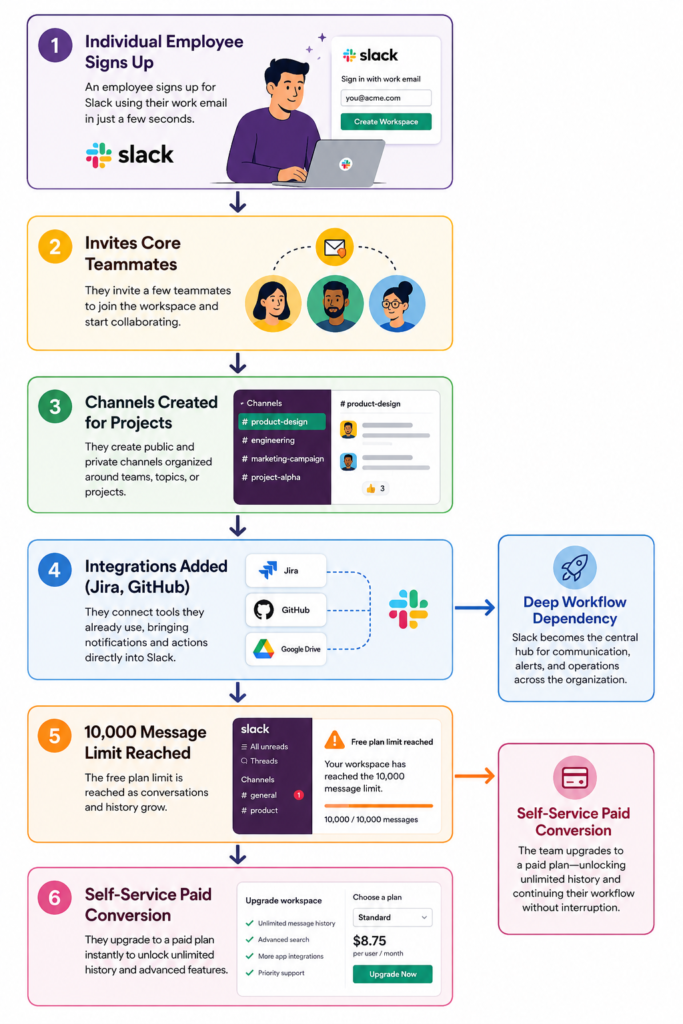
The company focused entirely on reducing time-to-first-value by allowing organizations to create functional communication workspaces in under three minutes. Slack built an open API ecosystem that allowed engineering and marketing teams to route automated event alerts from systems like GitHub, Jira, and Google Drive directly into chat channels, making the app the central operating desk for daily tasks.
Monetization Framework and Price Realization
Monetization steps are enforced by clear platform usage barriers:
- Free tier restricting searchable message history to 10,000 items and limiting third-party integrations to 10 connections.
- Pro tier charging $7.25 to $8.75 per user monthly to remove message archive caps and enable external guest access.
- Business Plus tier charging $12.50 to $15 per user monthly for corporate compliance exports and 99.99% uptime guarantees.
- Enterprise Grid deploying custom pricing architecture for large organizations requiring partitioned workspaces and data governance controls.
Startup Lesson for Founders
Horizontal software expansion across diverse corporate divisions becomes highly predictable when the core product solves a narrow, high-friction operational problem while utilizing consumer-grade design patterns that eliminate onboarding friction.
3. HubSpot
What They Built
HubSpot Incorporated engineered an enterprise cloud software platform that unifies customer relationship management, inbound marketing automation, outbound sales pipelines, customer support helpdesks, and content management systems.
Financial Track and Investment Data
Founded in Cambridge, Massachusetts, HubSpot raised $100 million in private venture funding before executing an initial public offering in October 2014, raising $125 million at a market capitalization of $759 million.
The company transitioned into a highly profitable enterprise, growing its annual revenue past $2.1 billion by 2023 with gross operating margins holding at 84%. HubSpot sustains its market expansion by maintaining an optimal Lifetime Value to Customer Acquisition Cost ratio above 5:1, driven by multi-hub product expansion within small and mid-market companies.
Growth Strategy and Distribution Channels
HubSpot dominated the competitive business software market by creating and owning the inbound marketing methodology, turning educational content distribution into a long-term acquisition barrier. The company built an extensive digital network of search-optimized blogs, free template generators, and the HubSpot Academy certification system.
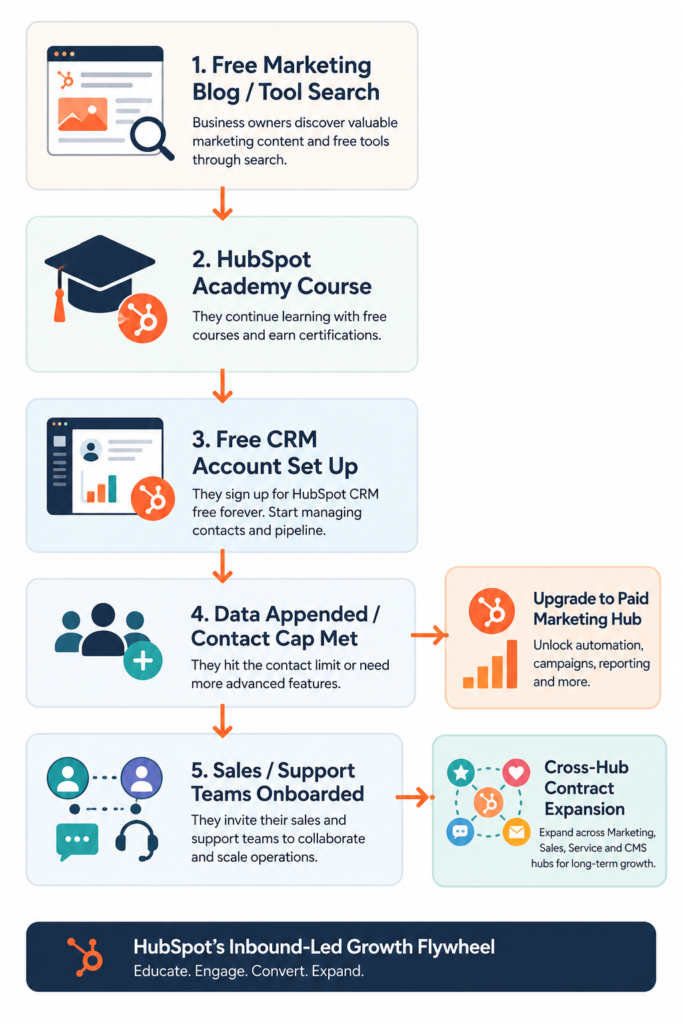
This education engine attracted hundreds of thousands of business operators looking for marketing strategies, allowing HubSpot to capture high-intent leads without relying on cold outbound calling or expensive paid digital ads. The platform provided a free, highly capable core CRM database that served as a low-friction entry point, allowing them to cross-sell specialized marketing, sales, and support hubs as the client’s business grew.
Monetization Framework and Price Realization
Subscription scaling is determined by feature depth and contact volume tiers:
- Free tier providing essential customer relationship contact ledgers and basic email form captures.
- Starter tiers beginning at $15 to $20 monthly for removal of platform branding on emails and standard forms.
- Professional tiers scaling from $450 to $800 monthly for automated marketing workflows, A/B testing, and custom reporting dashboards.
- Enterprise tiers starting at $1,200 to $3,600 monthly for advanced lead scoring algorithms, multi-touch attribution models, and advanced permission hierarchies.
Startup Lesson for Founders
Educational content distribution and professional certification programs establish an enduring customer acquisition moat when the instructional infrastructure directly highlights the practical need for your product suite.
4. Datadog
What They Built
Datadog Incorporated developed an enterprise cloud observability and monitoring platform that aggregates server logs, infrastructure telemetry metrics, application performance data, and real-time security events for DevOps and systems engineering teams.
Financial Track and Investment Data
Launched in New York City, Datadog secured $147 million in private capital from venture firms including Index Ventures and RTP Global before executing its initial public offering in September 2019. The company raised $648 million at its market debut, reaching a valuation of $7.8 billion.
Datadog operates with exceptional capital efficiency, expanding its annual recurring revenue past $2.2 billion by 2024 while generating hundreds of millions of dollars in free cash flow, supported by net revenue retention rates that hover between 115% and 130%.
Growth Strategy and Distribution Channels
Datadog’s expansion leveraged the global corporate transition from legacy on-premise servers to complex, highly distributed multi-cloud architectures. The platform engineered a lightweight infrastructure agent that engineers could install across thousands of cloud servers within minutes, providing immediate visibility into system performance gaps.
The platform avoided single-product limitations by systematically launching complementary modules for log management, application performance monitoring, network telemetry, and cloud security monitoring. Because these modules share a single interface and data agent, engineering organizations regularly expand their usage from basic server monitoring to deep enterprise observability without needing additional vendor onboarding reviews.
Monetization Framework and Price Realization
The usage-based billing platform applies separate rates for individual telemetry types:
- Infrastructure monitoring starting at $15 to $23 per host monthly based on data retention rules.
- Application Performance Monitoring (APM) charging $31 to $40 per host monthly for end-to-end distributed tracing.
- Log Management billing $0.10 per gigabyte of ingested data combined with variable storage retention rates.
- Real User Monitoring charging $15 per 10,000 monthly sessions to track frontend interface performance.
- Cloud Security Management charging $7.50 per host monthly for real-time compliance tracking and vulnerability scanning.
Startup Lesson for Founders
The most defensible cloud software businesses position their technology as mission-critical operating infrastructure embedded inside the client’s core data flows, making removal an expensive operational risk.
5. Zapier
What They Built
Zapier Incorporated constructed an automated workflow orchestration platform that enables non-technical business professionals to connect disparate software applications and automate data synchronization tasks without writing code.
Financial Track and Investment Data
Zapier represents one of the most capital-efficient enterprises in modern technology history. The company accepted only $1.3 million in seed stage venture capital from Y Combinator and Bessemer Venture Partners in 2012, achieving profitability within nine months of operation.
By operating with strict financial discipline, the company scaled past $140 million in ARR by 2021 and maintains high cash reserves while employing a fully distributed global workforce, eliminating the need for subsequent institutional funding dilution.
Growth Strategy and Distribution Channels
Zapier built a highly automated customer acquisition engine by leveraging programmatic search engine optimization and programmatic landing page generation. The company engineered an index system that automatically deployed dedicated landing pages whenever a software vendor integrated with their API ecosystem.
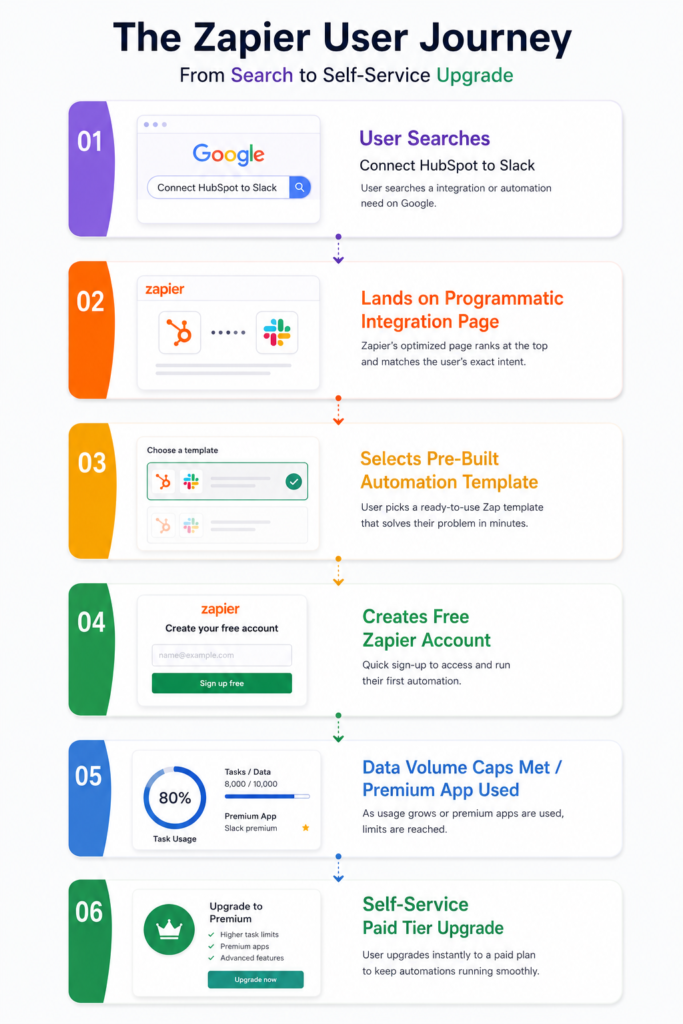
If a user searches Google for a term like how to connect HubSpot to Slack, Zapier’s dedicated integration page ranks at the top of the search engine results. This system targeted long-tail integration searches across thousands of applications, capturing high-intent traffic and directing users to pre-built automation templates that delivered functional workflows within five minutes.
Monetization Framework and Price Realization
Monetization tiers scale based on task execution volume and automation complexity:
- Free tier allowing the execution of 100 single-step automation tasks monthly across standard applications.
- Professional tier charging $20 to $30 monthly for multi-step automation logic, custom formatting filters, and conditional paths.
- Team tier charging $69 to $100 monthly for shared workspace directories, joint app connections, and accelerated execution speeds.
- Company tier utilizing custom annual configurations for advanced data governance, audit logging, and single sign-on administration.
Startup Lesson for Founders
Programmatic search engine optimization and platform ecosystem integrations can establish a low-cost, automated customer acquisition pipeline for software vendors operating inside fragmented tool markets.
6. Snowflake
What They Built
Snowflake Incorporated engineered a cloud-native data warehousing platform that separates computing power from storage resources, allowing enterprise data teams to execute high-performance analytics queries across massive unstructured data sets.
Financial Track and Investment Data
Founded in San Mateo, California, Snowflake raised over $1.4 billion in private capital from prominent technology investment firms including Sutter Hill Ventures, Altimeter Capital, and Iconiq Capital.
In September 2020, the company executed the largest software initial public offering in history, raising $3.36 billion and reaching a market valuation of $70 billion. The company grew its revenue past $2.8 billion by 2024, running on strong enterprise customer expansion metrics that regularly produce net revenue retention rates above 120%.
Growth Strategy and Distribution Channels
Snowflake accelerated its enterprise market entry by completely changing traditional on-premise database economic patterns. Legacy systems required corporations to purchase expensive, rigid database appliances with fixed computing and storage limitations, which routinely caused system crashes or long delays during intense query executions.
Snowflake’s cloud-native architecture allowed enterprise data engineers to scale computing resources up or down instantly based on processing demands without affecting their primary data storage layer. The company focused its distribution strategy directly on major corporate data migration projects, deploying technical solutions architects to demonstrate how their engine could reduce query processing costs from hours to seconds.
Monetization Framework and Price Realization
The platform bypasses fixed subscription models in favor of pure consumption billing:
- Compute resources billed dynamically via Snowflake credits based on warehouse size and exact execution runtime.
- Storage capacity charged at a flat monthly rate per terabyte of data compressed within cloud environments.
- Data transfer fees structured around standard cloud egress volumes across different cloud networks and geographic regions.
Startup Lesson for Founders
SaaS enterprises that align their core technology and pricing systems with large, structural enterprise technology shifts can capture massive high-value contracts and achieve fast corporate adoption cycles.
7. Canva
What They Built
Canva Proprietary Limited developed a drag-and-drop graphic design web application that simplifies visual asset creation, brand management, presentation formatting, and video editing for non-professional designers.
Financial Track and Investment Data
Launched in Sydney, Australia, Canva faced early resistance from traditional venture firms before securing over $570 million across subsequent funding rounds from institutional backers including Blackbird Ventures, Sequoia Capital China, and Franklin Templeton.
The company reached a private market valuation of $40 billion by late 2021, supported by annual revenues that crossed $2 billion by 2024. Canva maintains strong financial positions by serving a global user base exceeding 170 million active individuals monthly with low user churn rates.
Growth Strategy and Distribution Channels
Canva accelerated its distribution by removing the steep learning curves and high software licensing costs associated with professional design suites like Adobe Photoshop. The platform provided thousands of pre-configured templates tailored to specific use cases like social media graphics, corporate presentations, and educational flyers.
The company implemented a highly efficient freemium model that allowed users to design and download high-quality graphics entirely for free. When users wanted to resize an image instantly, organize brand color kits, or access premium stock photography assets, the platform placed clear feature options that drove self-service upgrades to paid premium individual or group subscriptions.
Monetization Framework and Price Realization
Monetization pathways target both independent creators and cross-department collaboration units:
- Free tier offering basic drag-and-drop mechanics, standard layout templates, and 5 gigabytes of cloud storage.
- Canva Pro charging $120 to $150 annually per individual for premium font uploads, asset catalog access, and automated image resizing.
- Canva for Teams charging $100 to $130 annually per user for shared brand asset directories, design approval workflows, and collaborative real-time editing.
- Enterprise tier utilizing custom configurations for single sign-on deployment, advanced asset security, and dedicated account support.
Startup Lesson for Founders
Massive market adoption can be achieved by simplifying complex professional workflows for mainstream business users rather than designing features only for technical specialists.
The Operational Patterns Shared by Fast-Growing SaaS Companies
Sustained enterprise velocity is rarely the byproduct of market timing alone. When analyzing a high-performing list of saas companies, distinct operational patterns emerge across their engineering, product design, and go-to-market architectures.
Aggressive Reduction of Time-to-Value (TTV)
The highest-growth software vendors design their systems to minimize the delay between initial user authentication and meaningful product utility. Legacy enterprise applications frequently required multi-week implementation cycles, professional services intervention, and extensive administrator training before delivering operational utility. Modern high-retention platforms treat the initial user session as a critical conversion event.
Rapid execution of time-to-value directly yields:
- Higher Activation Rates: Users transition from raw signups to active core feature operators within the first 24 hours.
- Elevated Long-Term Retention: Early exposure to core utility structurally lowers the probability of platform abandonment.
- Accelerated Self-Service Conversion: Users self-monetize rapidly when product capabilities match immediate operational needs.
- Compounded Account Expansion: Fast-activated workspaces invite additional team members early in the subscription lifecycle.
Embedded Expansion Revenue Frameworks
The strongest business models are engineered so that account valuation scales automatically without requiring continuous intervention from account management or customer success teams. Rather than treating customer acquisition as a static transactional event, fast-scaling enterprises embed expansion triggers natively into the product architecture.
This systematic expansion is achieved through four core architectural vectors:
- Seat Growth: Team workspaces require per-user license expansion as collaboration extends across departments.
- Usage Growth: Computational utilization, API calls, or database capacity metrics automatically advance accounts into higher billing tiers.
- Feature Expansion: Advanced corporate capabilities—such as automated data masking, single sign-on security, or deep analytics reporting—are partitioned behind premium tiers.
- Infrastructure Dependency: The application matures into a central data repository or primary execution layer, making data extraction operationally prohibitive.
Algorithmic Growth-Aligned Pricing
Modern business software pricing structures have moved away from rigid, unyielding flat-rate enterprise contracts. Instead, top-tier operators utilize flexible monetization frameworks that align financial outlays directly with the operational scale of the customer.
| Pricing Metric | Operational Metric Tracked | Enterprise Value Proposition |
| API Volume | Data synchronization traffic | Scales directly with transactional infrastructure utilization |
| Storage Usage | Data volume compressed in cloud instances | Monetizes the long-term data custody footprint |
| Active Users | Verified unique logins within a billing cycle | Ensures the customer pays only for utilized access licenses |
| Workspace Size | Distinct departmental collaboration directories | Captures value as organizational adoption expands |
| Workflow Volume | Executed automation pipelines or processing runs | Charges based on the direct labor-saving value delivered |
Structural Workflow Embedding
Software longevity is a direct function of operational dependency. High-retention cloud applications do not operate as isolated destination utilities; instead, they embed themselves directly into the structural communication channels, security layers, analytics workflows, and automated reporting systems of an enterprise.
When a platform serves as the definitive database, central communication layer, or vital integration bridge between fragmented systems, it achieves a deep level of organizational permanence. The labor expense, data migration risk, and operational disruption required to deprecate such deeply integrated software create a structural barrier against competitor entry, lowering system churn to near-zero levels.
What New SaaS Startups Should Learn From These Companies
Distribution Matters as Much as Product Quality
A common failure mode for early-stage engineering founders is operating under the assumption that building superior software code inherently solves customer acquisition. In highly saturated digital software ecosystems, distribution strategy dictates enterprise survival.
Successful market entrants typically dominate at least one core customer acquisition channel before diversifying their distribution footprint. Whether a venture leverages programmatic search engine optimization, engineering-led product-led growth, highly targeted outbound enterprise sales, developer community ecosystems, or strategic application marketplace integrations, a scalable, predictable pipeline must be established to prevent capitalization exhaustion.
Broad Target Markets Are Dangerous Early
Attempting to build horizontal applications that serve unsegmented customer profiles is a primary driver of early-stage corporate failure. The fastest-growing software platforms almost universally initiated operations by isolating a narrow, high-friction operational pain point within a specific target industry or workflow before attempting broad market expansion.
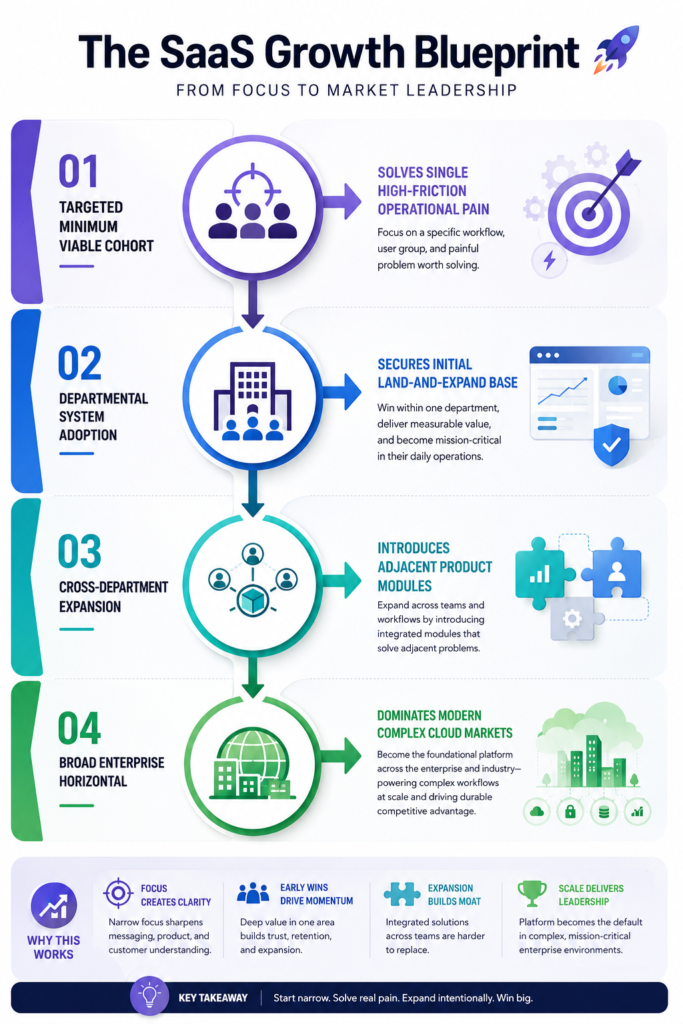
Ventures that deploy products to a non-specific audience encounter immediate operational headwinds: positioning messaging becomes dilute, advertising acquisition costs expand inefficiently, and engineering velocity stalls due to conflicting product demands from divergent user classes.
Retention Is More Valuable Than Viral Growth
While high-velocity customer acquisition captures public market visibility, long-term enterprise sustainability is governed by retention economics. A company that exhibits strong net revenue retention alongside robust account expansion metrics can consistently outscale capitalized competitors that rely on heavy marketing expenditures to offset high customer attrition. Premium enterprise valuations are assigned to businesses that demonstrate predictable, high-margin recurring cash flows rather than temporary conversion spikes driven by promotional marketing spend.
Operational Complexity Creates Opportunity
The ongoing proliferation of hybrid work structures, fragmented application ecosystems, distributed multi-cloud architectures, complex data compliance mandates, and artificial intelligence integration layers has created unprecedented operational complexity for modern enterprises.
New cloud venture opportunities emerge precisely where corporate workflows become too intricate, manual, or data-intensive to manage efficiently through standard spreadsheets or legacy systems. Founders build significant enterprise value by designing targeted platforms that abstract away this systemic friction, transforming complex backend data orchestrations into clean, accessible user interfaces.
Metrics Investors and Founders Watch Closely in SaaS
Evaluating the financial health and operational efficiency of a subscription software company requires monitoring distinct key performance indicators that isolate recurring revenue quality from vanity growth trends.
Customer Acquisition Cost (CAC)
CAC quantifies the total fully loaded sales and marketing expenditures required to secure a single net-new customer account.
CAC=Number of New Customers AcquiredTotal Sales & Marketing Expenses
This metric serves as the definitive baseline for assessing the financial efficiency of a company’s distribution channels.
Lifetime Value (LTV)
LTV projects the net gross profit contribution an individual customer account is expected to generate over the entire duration of their subscription relationship.
LTV=Churn RateAverage Revenue Per Account×Gross Margin
Comparing LTV directly against CAC determines whether a marketing model can profitably scale over an extended time horizon.
Net Revenue Retention (NRR)
NRR measures the change in recurring revenue generated from an existing customer cohort over a specified period, accounting for expansion MRR, upgrades, and downgrades, while isolating the impact of net-new customer acquisitions.
NRR=Starting ARRStarting ARR+Expansion ARR−Contraction ARR−Churned ARR×100
Top-tier enterprise operations maintain NRR figures above 120%, demonstrating that their existing accounts naturally expand in financial value independent of new sales acquisitions.
Churn Rate
This represents the percentage of annualized or monthly recurring revenue lost due to contract cancellations and non-renewals within a designated time cohort. High churn indications highlight an underlying mismatch between product capabilities and ideal target profiles.
Activation Rate
The metric tracks the percentage of total signups that successfully complete a designated milestone sequence within the application interface that confirms they have derived actual value from the application.
Burn Multiple
The metric measures management’s capital efficiency by comparing net consumed venture capital directly against the generation of net-new Annual Recurring Revenue.
Burn Multiple=Net New ARR AddedNet Cash Burned
A lower Burn Multiple indicates highly efficient internal scaling mechanics, whereas a high multiple reveals that the company is spending excessively to manufacture top-line growth.
FAQ: List of SaaS Companies and Growth Strategies
What is a SaaS company?
A Software-as-a-Service (SaaS) company architects, hosts, and maintains software applications centrally on cloud infrastructure, delivering application access to global end-users via recurring monthly or annual subscription models. This replaces legacy on-premise permanent software license installations and custom corporate hardware management requirements.
Why do some SaaS companies grow faster than others?
Accelerated scaling occurs when a platform targets an urgent operational budget line, drives time-to-value below ten minutes, integrates smoothly into core daily enterprise workflows, and uses usage-based pricing models that scale revenue automatically as the customer’s business grows.
What is the most effective SaaS business model today?
Modern enterprise data shows that hybrid SaaS distribution models yield the highest efficiency. These architectures leverage low-friction, product-led self-service pipelines to secure early user adoption across individual departments, then route high-usage workspaces to enterprise sales teams who secure comprehensive, sitewide corporate licensing contracts.
Which SaaS companies use product-led growth?
Prominent industry leaders, including Notion, Canva, Slack, and Zapier constructed their market distribution around product-led growth principles, allowing individual users to authenticate, onboard, and unlock direct utility autonomously prior to requesting formal corporate procurement approval.
Why is expansion revenue important in SaaS?
Expansion revenue captures increased financial contributions from an existing customer base via automated seat additions, advanced feature tier upgrades, or usage volume expansion. Cultivating strong expansion dynamics establishes a highly efficient revenue engine that can drive company scale even during periods of macroeconomic contraction or reduced net-new customer acquisition.
Which industries currently create strong SaaS opportunities?
High-growth opportunities remain dense across sectors managing systemic technical friction, particularly in AI infrastructure development, cybersecurity architecture, cloud environment monitoring, automated enterprise compliance tracking, and highly tailored vertical SaaS applications optimized for historically under-digitized legacy operations.