Digital commerce is expanding rapidly across every global sector, moving far beyond the boundaries of traditional retail. Today, manufacturers, wholesalers, high-volume distributors, and direct-to-consumer brands are all scaling their operations online. This rapid migration is heavily driven by a fundamental shift in procurement psychology, as modern business buyers now expect the same seamless, intuitive shopping experiences they encounter as everyday consumers.
According to data from McKinsey, nearly 70% of B2B decision-makers now prefer remote human interactions or digital self-service across the entire purchasing journey. This shift proves that digital channels are no longer just an alternative procurement option, but rather the preferred standard. Recent market projections from Statista indicate that global B2B eCommerce sales will surpass $36 trillion by the late 2020s, dwarfing the consumer market in total transaction value.
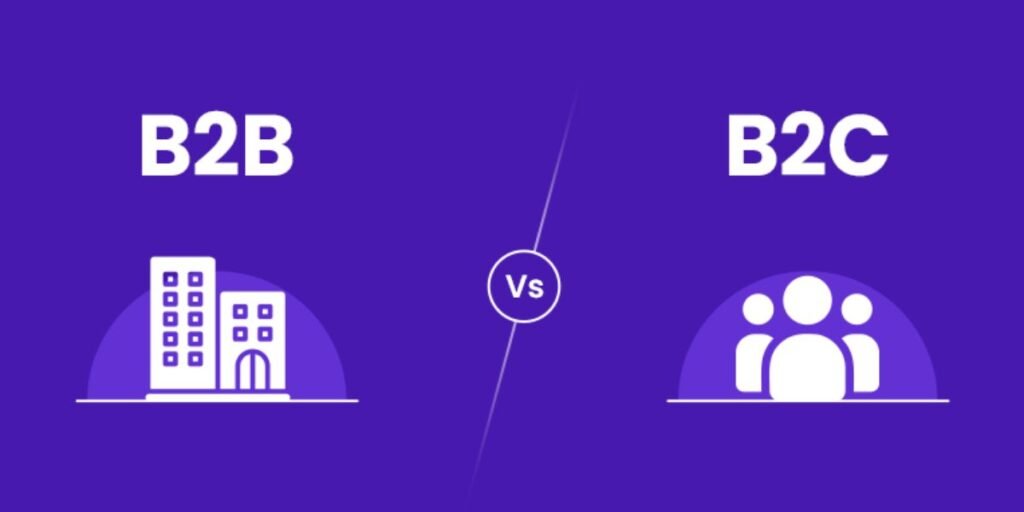
At its core, the primary difference between B2B and B2C eCommerce lies in the target audience and the structural complexity of the transaction. B2B, or Business-to-Business eCommerce, involves commercial transactions between two corporate entities, characterized by multi-tiered approval workflows, volume-based pricing, and long-term contractual agreements. Conversely, B2C, or Business-to-Consumer eCommerce, focuses on direct sales from a business to individual end-users, relying on fixed retail pricing, immediate payment processing, and fast, emotion-driven purchasing cycles.
Understanding B2B eCommerce
Business-to-Business digital commerce refers to the online exchange of products, services, or information between commercial enterprises rather than individual shoppers. The fundamental operational framework here is highly structured, as procurement involves professional buyers who must justify expenses based on organizational utility, return on investment, and strict operational requirements.
The purchasing cycle in this domain rarely mimics a simple retail checkout. Instead, it follows a multi-stage workflow that includes formal vendor onboarding, credit checks, budget allocations, and compliance reviews. Individual buyers act on behalf of an enterprise, meaning their purchasing choices are guided by corporate logic, technical specifications, and strict budget constraints.
Order volumes in B2B environments are inherently large, often moving in pallet loads, truckloads, or container shipments. Because of these massive quantities, transactions rely on contract-based pricing where unit costs decrease as purchase volumes increase. Payment is rarely settled at checkout via standard credit cards. Instead, businesses use formal purchase orders and trade credit, allowing buyers to settle balances on structured terms like Net 30 or Net 60 days.
Several major industries rely heavily on these digital frameworks to keep supply chains moving:
- Industrial Suppliers: Companies distributing heavy machinery, precision manufacturing components, MRO supplies, and factory automation gear.
- Medical Equipment Distributors: Outlets supplying specialized diagnostics machinery, surgical instruments, and high-volume pharmaceuticals to hospital networks.
- Wholesale Distributors: Intermediaries moving bulk consumer packaged goods, construction materials, or agricultural supplies to downstream retail businesses.
Real-world market leaders have built highly sophisticated digital systems to handle these complex transactions at scale:
- Amazon Business: A dedicated corporate marketplace providing millions of business-specific products, quantity discounts, and multi-user corporate accounts.
- Grainger: An industrial supply giant utilizing advanced digital catalogs to offer millions of maintenance, repair, and operations products to enterprise clients.
- Alibaba.com: A massive global B2B marketplace connecting international manufacturers with wholesalers and sourcing professionals worldwide.
Understanding B2C eCommerce
Business-to-Consumer digital commerce focuses entirely on selling products and services directly to individual end-users. The operational infrastructure is built to support high-volume, low-value transactions, prioritizing user experience, immediate friction-free checkout, and emotional brand connection.
Individual purchasing behavior in the consumer market is driven by personal needs, lifestyle preferences, and immediate desires. While logic plays a role, emotional factors such as status, aesthetics, peer reviews, and promotional urgency heavily influence the final click. The decision-making process is typically solitary and instantaneous, allowing a buyer to discover a product on social media and complete the purchase within minutes.
Pricing in the consumer space is fixed and universally transparent. Every visitor to a specific online storefront sees the exact same price tag, barring localized tax variations or public discount codes. The entire transaction moves rapidly, with funds captured immediately at the point of sale using consumer financing, debit cards, or digital wallets.
Mobile commerce, or mCommerce, dominates this landscape. Brands spend significant resources optimizing their mobile web interfaces and dedicated shopping apps to capture buyers on the go. To maintain a steady stream of revenue, companies implement sophisticated loyalty programs, gamified rewards, and highly targeted retargeting ads to maximize repeat purchases.
Prominent global examples span across diverse lifestyle and utility sectors:
- Nike: A premier sportswear brand driving massive revenue through direct-to-consumer digital applications, exclusive product drops, and personalized member apps.
- Apple: A technology titan combining premium digital storefront aesthetics with trade-in programs and smooth ecosystem checkouts.
- Sephora: A beauty retail giant utilizing augmented reality shade-matching, highly personalized product recommendations, and an industry-leading rewards program.
What Is the Difference Between B2B and B2C eCommerce?
| Comparison Metric | B2B eCommerce | B2C eCommerce |
| Target Customer | Corporate entities, procurement teams, and business owners | Individual consumers and households |
| Purchase Motivation | Operational efficiency, profit margins, and business utility | Personal need, entertainment, status, and emotional desire |
| Decision-Making Process | Multi-stage evaluation involving multiple corporate stakeholders | Solitary decision-making or minimal consultation with family |
| Average Order Value | Exceptionally high, often ranging from thousands to millions of dollars | Lower average order value, typically under a few hundred dollars |
| Sales Cycle | Long and consultative, lasting weeks, months, or even quarters | Short, immediate, and often completed in a single session |
| Pricing | Dynamic, negotiated, contract-based, and customer-specific | Publicly visible, fixed, and standardized for all shoppers |
| Payment Methods | Purchase orders, trade credit lines, Net 30/60/90, and bank wires | Credit cards, debit cards, digital wallets, and BNPL |
| Customer Relationships | High-touch, long-term partnerships with dedicated account managers | Transactional, managed via automated marketing and self-service |
| Marketing Strategy | Account-Based Marketing, whitepapers, data-driven demos, and LinkedIn | Social media ads, influencer partnerships, and emotional storytelling |
| Technology Infrastructure | Complex ecosystems integrated with ERP, CRM, CPQ, and PunchOut systems | Sleek frontend storefronts focused on speed and merchandising |
| Shipping & Logistics | Freight, LTL shipping, scheduled deliveries, and multi-warehouse routing | Parcel shipping, home delivery, and buy-online-pickup-in-store |
| Customer Support | Specialized technical support and dedicated account reps | Automated chatbots, self-service help centers, and tier-1 agents |
| Customer Lifetime Value | Exceptionally high due to recurring, long-term supply contracts | Variable, driven by brand loyalty and repeat purchase frequency |
Why B2B Buying Decisions Involve More Than One Person
Unlike consumer shopping, where a single person holds total purchasing power, enterprise procurement requires collective agreement. Data from Forrester shows that the typical enterprise purchase now involves an average of 6 to 10 stakeholders, each representing a distinct department within the organization. This buying committee evaluates every transaction through different lenses to mitigate corporate risk and ensure operational alignment.
The procurement team leads the logistical negotiation, ensuring the vendor complies with corporate supply standards and delivery schedules. Concurrently, the finance department scrutinizes the payment terms, cash flow impact, and return on investment projections. Operations teams assess how the new product or service integrates into daily workflows, ensuring it won’t cause costly downtime.
Meanwhile, IT and legal departments conduct rigorous technical and regulatory reviews:
- IT Security: Evaluating software architecture, data encryption standards, API integration capabilities, and system compatibility.
- Legal Compliance: Assessing contract liabilities, service level agreements, intellectual property clauses, and data privacy regulations.
Because of this complex web of stakeholders, B2B eCommerce platforms must support multi-user corporate accounts with custom permission levels. A junior buyer might have the authority to create a cart, but the system must automatically route that cart through an internal approval workflow to a manager or financial officer before a purchase order can be generated.
Why Consumer Shopping Prioritizes Speed and Convenience
In the B2C arena, friction is the ultimate conversion killer. Because consumer shopping is driven by immediate needs or impulse desires, any obstacle in the user journey can cause cart abandonment. Microseconds of latency in page load times or a confusing layout will quickly send a shopper to a competitor’s storefront.
The entire B2C ecosystem is engineered around instant gratification. Features like one-click checkout, saved shipping profiles, and biometric authentication remove the physical effort from spending money. Mobile optimization is mandatory, as a massive portion of retail web traffic originates from smartphones during transit, breaks, or late-night browsing sessions.
Social commerce has further compressed the traditional sales funnel. Platforms like Instagram, TikTok, and YouTube allow users to buy products directly inside social feeds without ever leaving the app. This instant purchasing pathway relies heavily on social proof, user-generated videos, star ratings, and peer reviews to clear any hesitation in the buyer’s mind.
Personalization algorithms work behind the scenes to show the right product to the right user at the exact moment they are most likely to buy. By analyzing past browsing habits, geographic location, and local weather patterns, B2C storefronts dynamically alter their homepages, offer time-sensitive discounts, and show related products to maximize cart value before the consumer checks out.
Pricing Strategies Change Completely Between B2B and B2C
The financial structure of a B2C transaction is perfectly straightforward: the price listed on the product page is exactly what the buyer pays. Retailers can adjust prices globally using flash sales, seasonal markdowns, or dynamic pricing algorithms based on supply and demand, but the price remains uniform for every consumer looking at the screen.
In sharp contrast, B2B eCommerce completely rejects uniform pricing. Because business relationships are built on volume commitments and long-term contracts, pricing must be highly flexible and completely customized. When a corporate buyer logs into a B2B portal, they see a personalized price list that has been negotiated and coded specifically to their company account.
To handle these intricate arrangements, B2B platforms rely on several distinct pricing frameworks:
- Contract Pricing: Locked-in rates agreed upon during formal procurement negotiations, valid for a specific calendar year or contract term.
- Tiered & Volume Discounts: Systemized price breaks where the cost per unit drops significantly as the order volume crosses specific item thresholds.
- Request for Quote (RFQ) Workflows: Built-in digital forms that let buyers submit custom configurations or massive order lists directly to a sales representative to negotiate a custom price.
- Minimum Order Quantities (MOQ): Strict operational rules preventing checkouts unless the cart meets a minimum unit count or dollar threshold required to cover production and freight costs.
The Checkout Experience Reflects How Each Customer Buys
The final step of an online purchase reveals a stark contrast between corporate and consumer buyer behavior. A B2C checkout is designed to be completed in seconds using personal payment methods. The user selects their items, chooses a shipping speed, and pays immediately using standard debit cards, credit cards, or digital wallets like Apple Pay, Google Pay, and PayPal.
To lower entry barriers, B2C stores rely heavily on guest checkout, allowing users to buy without the hassle of setting up an account. Options for Buy Now, Pay Later (BNPL) allow consumers to split retail costs into small monthly installments, but the merchant still receives the full payment upfront from the financing partner.
A B2B checkout, however, is a complex financial and administrative workflow. Corporate buyers rarely pay with personal cards. Instead, the checkout system must integrate with established corporate credit lines. Buyers frequently enter a formal Purchase Order (PO) number, which triggers an automated accounting sync that bills the company via Net 30 or Net 60 payment terms.
The technical requirements of a business checkout screen must handle advanced corporate logistics, including:
- Split Shipping Addresses: Allowing a procurement manager to buy hundreds of items in a single transaction but distribute them across ten different regional factories or corporate offices.
- Tax Exemption Verification: Automatically processing corporate tax-exempt certificates or resale certificates in real time to deduct sales tax from the order total.
- Multi-Level Approvals: Halting the checkout flow until an automated email notification is approved by a departmental head or authorized financial officer.
Behind Every B2B Store Is a More Complex Technology Stack
A standard B2C eCommerce platform operates with a relatively direct technology stack. Its core focus is on the frontend user experience, conversion rate optimization, digital merchandising, fast search indexing, and real-time inventory tracking. While it connects to an Order Management System (OMS) and a basic shipping app, the architecture is built for rapid, straightforward data flows.
A B2B eCommerce portal, by contrast, is merely the visible layer of a deeply integrated enterprise technology ecosystem. A B2B storefront cannot operate in isolation because it relies on real-time data from core back-office legacy systems. If the connections between these systems fail, the digital storefront displays incorrect custom pricing, inaccurate inventory levels, or invalid credit terms.
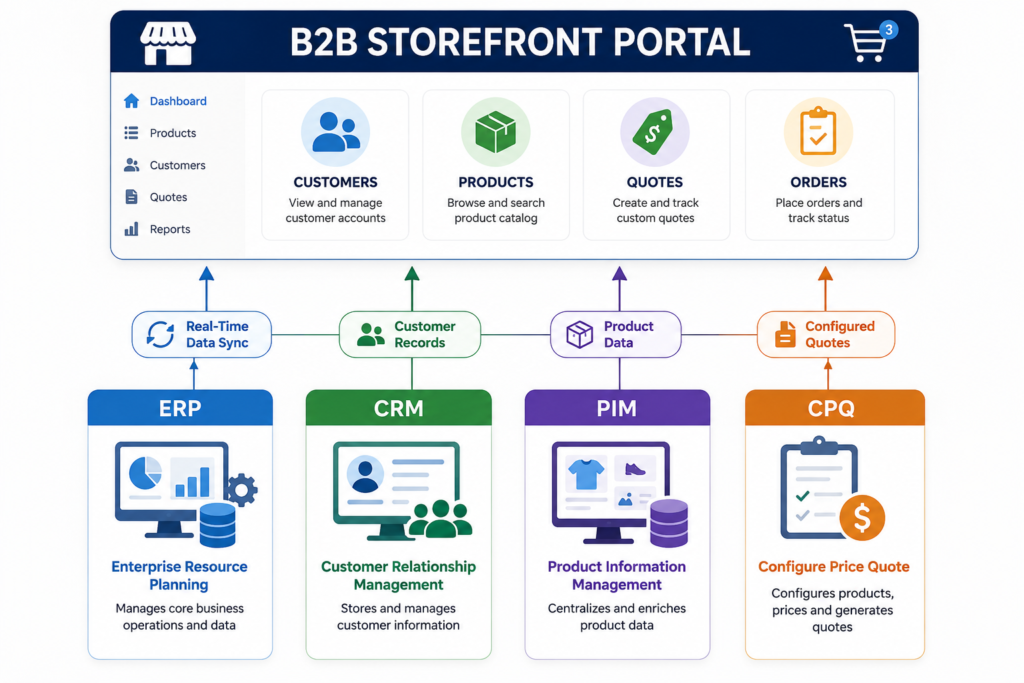
The enterprise infrastructure supporting a business portal requires specialized software layers working together simultaneously:
- Enterprise Resource Planning (ERP): The central database tracking corporate finances, raw material inventory, production schedules, and primary accounting records.
- Customer Relationship Management (CRM): The system holding negotiation notes, account health details, and assigned sales representative associations.
- Product Information Management (PIM): A dedicated repository managing hundreds of technical specifications, safety data sheets, regulatory certifications, and multi-language manuals for complex products.
- Configure, Price, Quote (CPQ): An algorithmic engine that allows buyers to customize complex industrial machinery or products online while calculating accurate pricing based on current contract rules.
- PunchOut Catalog Integrations: Specialized software protocols allowing a buyer’s internal procurement software (like SAP Ariba or Coupa) to launch and interact directly with the supplier’s web catalog.
Marketing Looks Very Different When Your Customer Is Another Business
B2C marketing relies on broad reach, emotional resonance, and cultural trends. Brands look to maximize impressions across mainstream social media networks, leverage influencer partnerships, and use striking visual creative to capture attention. The primary goal is to guide the consumer from initial product discovery to an online conversion in a very short window, often using coupon codes, limited-time promotions, and user-generated content.
B2B marketing entirely skips impulse-driven tactics, focusing instead on logic, professional utility, and building deep corporate trust. Because business buyers risk their professional reputation and substantial company budgets on every transaction, marketing materials must prove measurable economic value, absolute reliability, and clear operational return on investment.
To nurture prospects over months-long sales cycles, B2B marketers build highly targeted, information-rich content strategies:
- Account-Based Marketing (ABM): Crafting hyper-personalized digital ad campaigns and custom landing pages tailored exclusively to a few dozen high-value target corporations.
- Technical Whitepapers & Case Studies: Publishing exhaustively researched documents filled with concrete performance data, real-world implementations, and financial proofs.
- Interactive Product Demos & Webinars: Hosting live, deeply technical walkthroughs where engineering or product leads answer specific integration questions from prospective buyers.
- Sales Enablement Toolkits: Arming field sales representatives with comparative data sheets, ROI calculators, and specialized presentations to help internal champions convince their buying committees.
Customer Relationships Continue Long After the First Sale
In the consumer market, customer relationships are often brief and transactional. While brands put a lot of work into retention through loyalty points, automated birthday emails, and algorithmic product recommendations, consumers can easily switch to a competitor if they offer a cheaper price or faster shipping. Brand loyalty is fragile and constantly challenged by shifting retail trends.
B2B customer relationships are built to endure for years, operating more like strategic corporate partnerships. Acquiring a new business client requires an expensive sales cycle, which means long-term customer retention is absolutely vital to a company’s financial health. A successful transaction is not viewed as a single event, but rather the beginning of an ongoing, multi-year supply relationship.
To maintain these critical accounts, B2B organizations deploy dedicated customer success teams and professional account managers. These specialists regularly review account usage, proactively resolve logistics bottlenecks, and help optimize the client’s supply chain. Digital portals support this by offering automated subscription renewals, quick re-order buttons for historical supply sheets, and direct communication links to support staff.
Why Many Companies Now Operate Both B2B and B2C Channels
The historical divide between business-facing and consumer-facing commerce has blurred significantly over the past few years. Driven by the efficiency of cloud technology, many organizations are adopting hybrid business models. Manufacturers that previously sold exclusively to wholesale distributors are launching direct-to-consumer digital channels to capture higher profit margins and collect invaluable first-party customer data.
Concurrently, traditional B2C brands are expanding into B2B markets to find new wholesale revenue streams. For example, a consumer electronics company known for selling individual laptops to students might launch a dedicated corporate procurement portal to sell bulk hardware directly to enterprise IT departments.
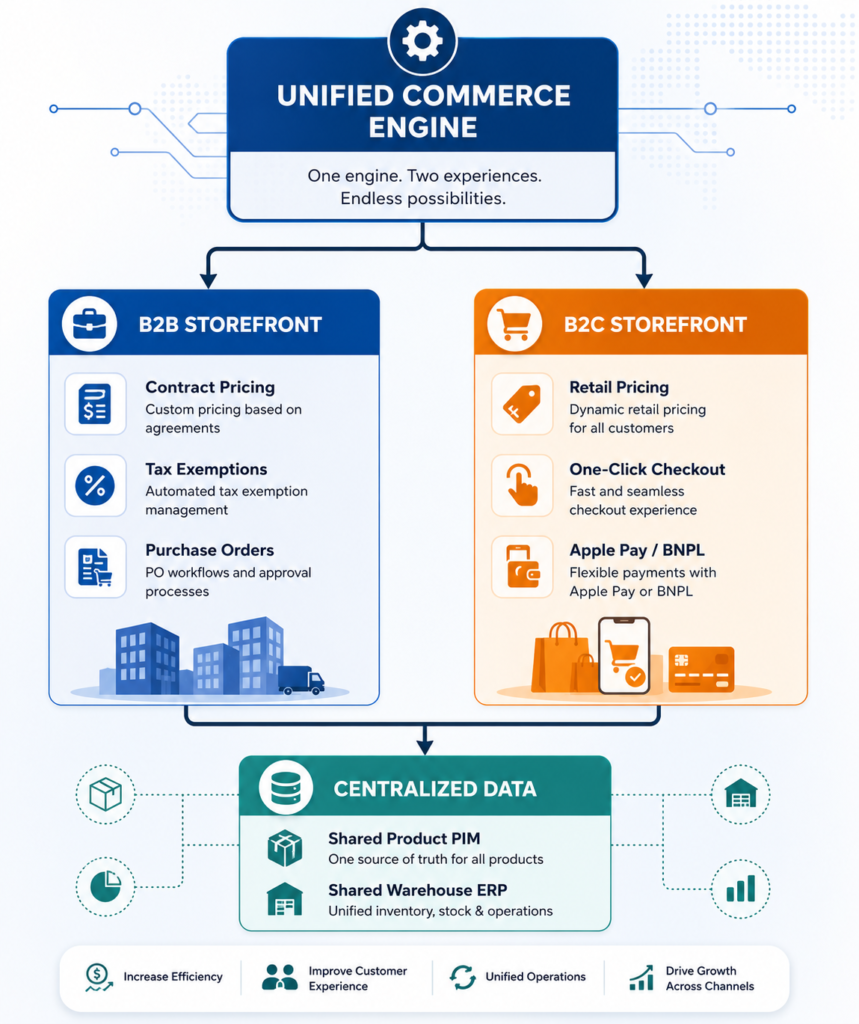
Successfully running a hybrid operation requires a unified commerce framework. Instead of managing completely isolated software systems for different sales arms, modern businesses use single-instance commerce platforms that segment users based on their login credentials. This centralized approach allows corporate groups to run multiple storefronts while sharing a master product catalog, central warehouse infrastructure, and core logistics networks.
Choosing Between B2B and B2C eCommerce
Deciding which digital commerce model to prioritize depends entirely on your product type, target audience, supply chain setup, and long-term business goals. Rather than viewing one system as superior, evaluate where your business fits within the broader commercial landscape to guide your digital strategy.
B2B is typically the better choice for:
- Industrial Components & Raw Materials: Companies manufacturing goods that require technical processing, manufacturing assembly, or integration into larger systems.
- Wholesale Distributors & Jobbers: High-volume intermediaries moving massive quantities of finished products to downstream regional retail networks.
- Enterprise Software Providers: SaaS organizations selling multi-seat licenses, deep software integrations, or corporate infrastructure tools.
B2C is often the better choice for:
- Apparel & Fast Fashion: Brands building lifestyle identities that rely on fast consumer trend cycles and visual social media marketing.
- Consumer Packaged Goods (CPG): Companies producing low-cost, high-velocity household items, snacks, or personal cosmetics meant for quick consumption.
- Boutique Home Goods & Electronics: Niche designers or gadget creators looking to sell directly to the end-user without retail middle layers.
A hybrid model works well for:
- Established Consumer Brands: Enterprise retail brands wanting to open bulk ordering pipelines for corporate gifting, corporate uniform supply, or authorized local dealerships.
- Primary Manufacturers: Component makers who want to supply both massive industrial partners via custom portals and individual hobbyists via a basic direct retail storefront.
Read More: How to Classify a Startup: Understanding SaaS, B2B, B2C, and Modern Business Models
Leading eCommerce Platforms for B2B and B2C Businesses
Selecting the right software foundation requires a deep look at your transactional needs, internal IT resources, and overall scale. A platform that excels at beautiful consumer visual storytelling might quickly falter when asked to manage complex B2B database queries and multi-tiered price lists.
Shopify Plus
Originally built as a pure consumer retail powerhouse, Shopify Plus has expanded its native B2B capabilities significantly. It allows mid-market and enterprise businesses to run both B2B and B2C storefronts out of a single centralized administrative dashboard. It is an excellent choice for businesses looking for fast deployment, low maintenance overhead, and user-friendly merchandising design tools, though it may require custom development for highly complex legacy ERP integrations.
Adobe Commerce
Built on the highly adaptable Magento framework, Adobe Commerce is an enterprise powerhouse capable of handling massive architectural complexity. It features robust, out-of-the-box B2B modules designed for custom company accounts, complex price sheets, and extensive RFQ workflows. It offers virtually unlimited customization and scalability for global brands with heavy IT resources, though it demands skilled developers to deploy and maintain.
BigCommerce
BigCommerce provides a highly flexible cloud solution with strong native B2B functionality through its dedicated B2B Edition. The platform uses an API-first approach, making it an excellent candidate for headless commerce setups where the front display layer is decoupled from the back data processing logic. It strikes a reliable balance for growing companies needing advanced multi-currency support, custom pricing structures, and complex ERP integrations without excessive maintenance costs.
OroCommerce
Unlike platforms that modified their existing consumer codebases to fit corporate needs, OroCommerce was architected from day one strictly for complex B2B enterprise transactions. It features an exceptionally powerful, built-in CRM, unmatched native workflow configuration engines, and advanced multi-organization corporate account management. It is ideal for large-scale industrial distributors and manufacturers with complex corporate structures, but it is not built for running fast consumer retail stores.
Frequently Asked Questions
1. What is the difference between B2B and B2C eCommerce?
The primary difference lies in the target audience, transactional scale, and structural complexity. B2B eCommerce involves transactions between businesses, utilizing custom contract pricing, large bulk orders, purchase orders, and multi-layered approval paths. B2C eCommerce involves businesses selling directly to individual consumers, relying on fixed retail prices, smaller order sizes, instant payment processing, and quick, user-friendly checkouts.
2. Which is better: B2B or B2C eCommerce?
Neither model is inherently better, as each serves an entirely different market purpose. B2B eCommerce yields significantly higher average order values and predictable, long-term recurring revenue streams, but it requires highly complex technology systems and long, consultative sales cycles. B2C eCommerce offers immediate cash conversion, faster product turns, and simpler transactional flows, but it is highly dependent on costly marketing spend and intense brand competition.
3. Can one business sell through both B2B and B2C eCommerce?
Yes, many companies now successfully operate using a hybrid model. Modern enterprise platforms enable brands to utilize a unified back-end system to power separate customer experiences. A single organization can run a public B2C site for standard retail shoppers while simultaneously running a secure, password-protected B2B portal where wholesale buyers log in to access contract prices and place bulk orders.
4. Why is the B2B buying process longer than B2C?
The B2B buying process takes longer because it involves significantly higher financial risks, larger budgets, and multiple stakeholders. A business purchase requires careful evaluations of return on investment, legal compliance checks, and IT integration reviews. This multi-person decision-making process requires formal approval workflows, contract negotiations, and vendor vetting before capital can be deployed.
5. Is Amazon B2B or B2C?
Amazon operates successfully as both a B2C and a B2B marketplace. The standard Amazon.com platform is the world’s largest B2C digital marketplace, serving individual consumers with fixed pricing and fast personal delivery. Concurrently, Amazon Business operates as a dedicated B2B marketplace, allowing verified corporate accounts to buy bulk goods, access business-only volume discounts, enter purchase orders, and integrate directly with corporate eProcurement platforms.
6. What features should a B2B eCommerce platform have?
A capable B2B platform must natively support custom customer price lists, multi-user corporate accounts with custom user permissions, automated approval workflows, and digital RFQ systems. It must also handle volume tier discounts, minimum order requirements, purchase order processing, tax exemption uploads, and deep, real-time sync capabilities with back-office ERP and CRM infrastructure.
7. Why do B2B companies use custom pricing instead of fixed prices?
B2B companies rely on custom pricing because their transactions are driven by commercial negotiations and long-term volume commitments. A distributor buying 10,000 units a month expects a much lower per-unit cost than a small shop buying 10 units a quarter. Custom price lists allow businesses to protect their profit margins while honoring specific contractual agreements made during formal procurement negotiations.
8. Can Shopify support both B2B and B2C eCommerce?
Yes, through its enterprise-tier Shopify Plus plan, Shopify natively supports both sales models from a single administrative system. Merchants can create a single online store that serves both audiences dynamically, displaying regular retail pricing to standard visitors while showing customized catalogs and negotiated payment terms to wholesale buyers who log into verified company profiles.