
Modern engineering environments rely heavily on automation, leaving organizations vulnerable to a critical security vulnerability known as credential sprawl. DevSecOps teams across global enterprises are tasked with managing tens of thousands of digital credentials. These include API keys, database passwords, TLS certificates, service accounts, and machine identities.
These sensitive assets are scattered across diverse environments. They live in public cloud platforms, ephemeral Kubernetes clusters, CI/CD pipelines, and infrastructure automation workflows. When an organization selects the wrong secrets architecture, it creates massive engineering friction. Misalignment leads to strict compliance failures, operational bottlenecks, and severe security gaps that leave infrastructure exposed.
This guide provides an objective, architecture-first evaluation of the leading enterprise secrets management platforms. Every solution is analyzed based on its real-world scalability, native integrations, access controls, governance frameworks, and operational overhead. The goal is to help your engineering leadership select a platform that aligns with your specific infrastructure and organizational maturity.
Not Every Enterprise Needs the Same Secrets Platform
The term best is fundamentally subjective in enterprise software architecture. The ideal secrets platform is determined by your current infrastructure footprint, team structure, and compliance obligations, rather than a vendor’s market share or popularity.
Organizations operating entirely within a single public cloud provider experience different operational realities than those managing legacy hybrid environments. A cloud-native team can easily leverage built-in provider tools to handle access controls. Conversely, an enterprise with on-premises datacenters and multiple cloud regions requires a platform-agnostic solution capable of bridging disconnected environments.
Kubernetes adoption also changes your architectural needs. Teams running heavy microservice workloads need automated, high-speed injection of credentials directly into pods, often at the rate of thousands of requests per second. If your platform cannot scale horizontally to meet this specific containerized demand, it becomes a single point of failure for your entire application runtime.
Compliance frameworks like SOC 2, ISO 27001, PCI-DSS, and HIPAA introduce strict technical requirements. Some industries mandate that cryptographic keys remain within specific geographic boundaries or physical Hardware Security Modules. If your organization operates under these constraints, a pure software-as-a-service model without localized encryption options is instantly disqualified.
Operational maturity and engineering team size represent the final pieces of the puzzle. A lean DevOps team cannot afford to dedicate two full-time engineers solely to maintaining, patching, and scaling a self-hosted secrets cluster. For these organizations, managed services or zero-knowledge SaaS platforms are far more practical, allowing engineers to focus on product delivery rather than infrastructure maintenance.
What Actually Matters in Enterprise Secret Management
Dynamic Secrets vs Static Credentials
Static credentials pose a permanent security risk because they remain valid until an engineer manually changes them. If a static database password leaks, the attacker enjoys indefinite access to the data layer.
Enterprise-grade platforms solve this through dynamic secrets generation. Instead of storing a permanent credential, the secrets manager connects directly to the target system, such as a database or cloud provider, and generates a unique, time-bound credential on the fly.
Once the requesting application finishes its task or the Time-to-Live expires, the secrets platform automatically deletes the credential at the destination. This reduces the blast radius of a potential leak to near zero.
Secret Rotation Without Service Interruption
Manual credential rotation is an operational burden that frequently leads to application downtime. True enterprise platforms orchestrate rotation programmatically via automated workflows.
The secrets manager must safely update the password in the target database, refresh the value inside the secrets vault, and notify running application instances to pick up the new credential. This entire process must occur without requiring a hard restart of the underlying services or disrupting active user sessions.
Fine-Grained Access Controls for Engineering Teams
A secure architecture requires strict adherence to the principle of least privilege. Enterprises need robust Role-Based Access Control and Attribute-Based Access Control models to govern how users and machines interact with sensitive data.
Access policies must scale dynamically by binding permissions to authenticated identities, network locations, or specific metadata attributes. Your platform should allow you to isolate development, staging, and production secrets completely, ensuring that an engineer or automated script only accesses the exact keys required for their specific context.
Auditability for Compliance and Incident Response
When a security incident occurs, forensic teams must immediately reconstruct the timeline of events. Enterprises require cryptographic, non-repudiable audit logs that record every single transaction within the secrets vault.
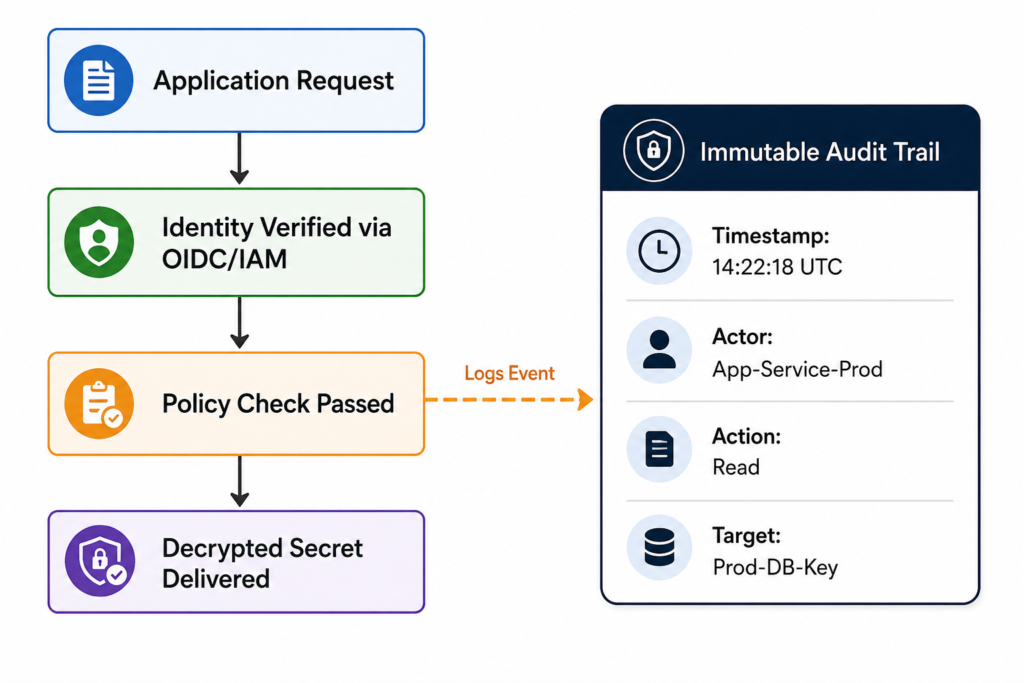
Every API call, login attempt, secret read, credential rotation, and policy modification must be logged in real time. These logs must stream directly to external Security Information and Event Management platforms, making them completely tamper-proof even if a local administrative account is compromised.
High Availability and Disaster Recovery
Because every deployment pipeline, microservice, and automated task requires credentials to function, the secrets manager sits directly in the critical path of your runtime environment. A localized outage can instantly paralyze your entire infrastructure.
Enterprises must evaluate a platform’s capability to perform multi-region replication, execute automated failovers, and maintain read-only availability during severe network partitions. The architecture must achieve a near-zero Recovery Time Objective to guarantee business continuity.
Support for Machine Identities and Automated Workloads
Modern infrastructure features far more machine-to-machine interactions than human-to-machine interactions. Secrets platforms must securely authenticate non-human actors, including continuous integration servers, configuration management scripts, and serverless functions.
This requires native support for modern identity federation standards such as OpenID Connect, cloud Identity and Access Management roles, and Kubernetes Service Accounts. Utilizing these existing identities allows the platform to eliminate the secret zero problem, where an application requires a master password just to fetch its operational secrets.
Native Integrations with CI/CD and Infrastructure as Code
Security tools must integrate seamlessly into existing workflows, or developers will actively find ways to bypass them. A production-ready secrets platform requires native plugins and extensions for popular DevOps tools like Terraform, Ansible, GitHub Actions, and GitLab CI.
These integrations should allow infrastructure code to reference secrets dynamically at runtime or build time, preventing plain-text values from ever being written to state files, version control systems, or public build logs.
Enterprise Secret Management Tools Compared
1. HashiCorp Vault
HashiCorp Vault remains the definitive architectural benchmark for enterprise secrets management, offering deep cryptographic control and an extensive feature set.
- Best Suited For: Large-scale, multi-cloud enterprises and hybrid environments requiring advanced cryptographic controls, dynamic secrets generation, and strict data isolation across complex infrastructure.
- Major Strengths: Exceptional flexibility with a robust plugin architecture. It provides true dynamic secrets across dozens of databases and cloud platforms, advanced transit data encryption, and robust multi-tenancy via enterprise namespaces.
- Operational Complexity: Extremely high. Operating self-hosted Vault clusters requires dedicated engineering resources to manage initialization unsealing, complex storage backends like Integrated Storage, and routine patching.
- Kubernetes Support: Excellent. Features native mutating admission controllers that inject secrets directly into ephemeral pod volumes as un-mutated memory files, preventing data from leaking to the local container disk.
- Enterprise Capabilities: Offers automated multi-region replication, advanced disaster recovery workflows, governance namespaces for business units, and physical Hardware Security Module integration for master key management.
- Potential Drawbacks: The licensing transition to the Business Source License has shifted commercial costs significantly. The platform demands a steep learning curve, and misconfigurations can easily lead to catastrophic cluster lockouts.
2. AWS Secrets Manager
AWS Secrets Manager provides a fully managed, highly integrated credential vault designed specifically for organizations operating inside the Amazon Web Services ecosystem.
- Best Suited For: Enterprises operating predominantly or exclusively on AWS infrastructure that prioritize zero maintenance overhead and native cloud security structures.
- Major Strengths: Complete out-of-the-box integration with AWS Identity and Access Management policies. It offers effortless automated rotation for native data stores like Amazon RDS, Redshift, and DocumentDB using pre-configured Lambda templates.
- Cost Considerations: Pricing is calculated at a flat rate of $0.40 per secret per month, combined with an additional charge of $0.05 per 10,000 API requests. For massive-scale enterprises managing millions of ephemeral keys, this transactional billing model can result in high monthly invoices.
- IAM Integration: Seamless. Access controls are governed using standard AWS IAM JSON policies, allowing security teams to reuse existing permission frameworks without inventing new policy languages.
- Automatic Rotation: Exceptional for native services. The platform automatically handles the rotation lifecycle by invoking isolated Lambda functions that update both the resource and the stored secret simultaneously.
- Enterprise Governance: Leverages AWS Organizations and Resource Access Manager to share secrets securely across multiple corporate accounts, while utilizing CloudTrail to provide comprehensive, unalterable API audit logging.
3. Azure Key Vault
Azure Key Vault is Microsoft’s cloud-native security solution, built to protect cryptographic keys, certificates, and secrets across the Azure ecosystem.
- Best Suited For: Enterprise environments deeply aligned with the Microsoft ecosystem, Azure Cloud Services, and Azure DevOps deployment pipelines.
- Major Strengths: Native, seamless integration with Azure Active Directory, which is now Microsoft Entra ID. It provides hardware-backed security via dedicated FIPS 140-2 Level 2 and Level 3 HSMs at a very predictable price point.
- Azure DevOps Integration: Direct and secure. Build pipelines can pull sensitive parameters straight from Key Vault instances during runtime without exposing text configurations in code repositories.
- Managed Identities: Strong. Eliminates the need for embedded developer credentials by allowing Azure virtual machines and App Services to authenticate directly against the vault using their system-assigned or user-assigned cloud identities.
- Enterprise Governance: Governed tightly by Azure Policy definitions, which allow security administrators to enforce strict rules across the entire organization, such as mandatory expiration dates and specific key lengths.
4. Google Cloud Secret Manager
Google Cloud Secret Manager is a streamlined, low-latency storage solution designed for secure credential management across Google Cloud Platform environments.
- Best Suited For: Cloud-native organizations running workloads primarily on GCP, Google Kubernetes Engine, or Google Cloud Run.
- Major Strengths: Exceptional global performance with automatic, turnkey data replication. It features a simplified, intuitive API surface that integrates directly with Google Cloud Identity and Access Management.
- IAM Model: Highly granular. Permissions are assigned directly to individual secrets or inherited globally from the project level, utilizing standard Google IAM service account roles.
- Cloud Run and GKE Integration: Excellent. Cloud Run services can mount secrets directly as environment variables or volume files at launch. GKE configurations utilize the open-source SecretStore CSI driver to sync assets securely into container spaces.
- Operational Simplicity: Very high. The platform requires zero infrastructure provisioning, scaling automatically to handle massive traffic spikes without demanding manual performance tuning or storage configuration.
5. CyberArk Conjur
CyberArk Conjur Enterprise focuses heavily on machine identity authentication, extending traditional Privileged Access Management capabilities deep into modern DevOps pipelines.
- Best Suited For: Highly regulated industries, such as banking, healthcare, and defense, that currently utilize CyberArk Core PAM to secure human credentials and need to extend those strict policies to automated workloads.
- Major Strengths: Unmatched enterprise compliance mapping. It bridges the gap between legacy infrastructure and modern cloud applications, offering deep deterministic auditing across hybrid environments.
- Privileged Access Management Focus: Unique. Conjur acts as a high-performance engine that pulls secrets directly from the central CyberArk Enterprise Password Vault, enforcing unified security policies across both human administrators and automated software tools.
- Security Architecture: Utilizes a highly robust, role-based access control engine that authenticates hosts based on multiple concrete attributes, including machine serial numbers, network subnets, and cryptographic image signatures.
6. Akeyless
Akeyless Vault is an innovative, cloud-native SaaS platform built on a patented decentralized cryptography architecture designed to replace traditional vault clusters.
- Best Suited For: Multi-cloud enterprises seeking to eliminate the operational overhead of running self-hosted secrets infrastructure, while maintaining absolute cryptographic data privacy.
- Major Strengths: Built upon unique Distributed Fragment Cryptography. This zero-knowledge design ensures that Akeyless never holds the complete encryption key, making it mathematically impossible for the vendor or a compromised third party to view your decrypted secrets.
- SaaS Architecture: True zero-maintenance model. There are no databases to scale, patches to apply, or high-availability nodes to configure, which dramatically reduces your total cost of ownership.
- Multi-Cloud Deployments: Highly capable. Operates as a universal stateless proxy that connects across AWS, GCP, Azure, and on-premises environments, offering a single control plane for global operations.
7. Doppler
Doppler prioritizes developer experience and automated synchronization to eliminate the configuration friction that frequently slows down engineering workflows.
- Best Suited For: Fast-growing organizations and agile enterprise development teams looking to replace manual configuration files with automated, real-time environment syncing.
- Major Strengths: Elite developer interface and command-line tool. It automatically synchronizes secrets across local development environments, CI/CD pipelines, and cloud hosting providers simultaneously.
- Developer Experience: Exceptional. Doppler eliminates the messy exchange of local configuration files among developers by providing a centralized dashboard that updates local environment variables instantly when changes occur.
- Scalability: Scales smoothly from small software startups up to large multi-team enterprise environments by utilizing robust access control hierarchies and automated change-management logs.
Read More: Fastest Growing Startups in the US Based on Funding, Revenue, and User Growth
8. Infisical
Infisical is a modern, developer-friendly, open-source secrets management platform built to give enterprises complete control over where and how their sensitive data is hosted.
- Best Suited For: Security-conscious development teams that require an open-source codebase, flexible self-hosting options, and automated secret synchronization workflows.
- Major Strengths: Fully open-source transparency combined with an intuitive web UI. It offers robust end-to-end encryption and a comprehensive suite of developer tools designed to prevent credential leaks early in the software lifecycle.
- Self-Hosting Flexibility: Excellent. Can be deployed effortlessly via Docker, Kubernetes, or AWS ECS, giving enterprises absolute data residency control without vendor lock-in.
- Kubernetes Integration: Native. Features a custom Kubernetes Operator that continuously syncs secrets directly into native Kubernetes Secret objects, keeping application deployments updated automatically.
9. 1Password Secrets Automation
1Password Secrets Automation brings the familiar, user-focused security model of corporate password management directly into machine-driven infrastructure pipelines.
- Best Suited For: Enterprises already utilizing 1Password for employee credential management that want to extend those existing vaults to secure automated services and development teams.
- Major Strengths: Eliminates the need to maintain duplicate vaults for human teams and machine tasks. It provides a clean, unified platform for tracking corporate credentials and application API tokens simultaneously.
- CI/CD Automation: Streamlined. Uses secure Connect servers deployed inside your private infrastructure to pull encrypted items from the cloud vault using secure, auditable token requests.
- Secret References: Highly efficient. Allows developers to place safe reference paths in source code instead of raw values, which are dynamically resolved at runtime by the local injection proxy.
10. Keeper Secrets Manager
Keeper Secrets Manager is a zero-knowledge, cloud-based platform engineered to secure infrastructure credentials through a fully automated, cloud-delivered network.
- Best Suited For: Compliance-focused organizations requiring a cloud-native platform with zero infrastructure footprint and strict multi-tenant access barriers.
- Major Strengths: True zero-knowledge architecture featuring client-side encryption. All stored attributes are encrypted locally on the device before transmission, ensuring data remains unreadable to external actors.
- Enterprise Governance: Provides exceptional granular control over team roles, administrative permissions, and device access vectors through a centralized, intuitive management interface.
- Compliance Alignment: Directly satisfies strict compliance requirements for frameworks like ITAR, CJIS, and FedRAMP by enforcing localized data storage and strict cryptographic isolation.
11. Bitwarden Secrets Manager
Bitwarden Secrets Manager provides an efficient, open-source approach to securing developer credentials, focusing heavily on value and architectural simplicity.
- Best Suited For: Mid-market enterprises and expanding organizations looking for a reliable, cost-effective, open-source secrets vault to protect development and deployment pipelines.
- Major Strengths: Exceptional code clarity and public auditing due to its fully open-source model. It delivers a highly competitive pricing structure that avoids the heavy financial commitments demanded by legacy enterprise vendors.
- Open-Source Ecosystem: Strong. Backed by a massive global community of security researchers, ensuring rapid vulnerability identification, transparent patching schedules, and robust independent verification.
- SMB to Enterprise Transition: Built with an emphasis on ease of use, allowing teams to transition smoothly from basic, unencrypted configuration files to a centralized, access-controlled vaulting system.
12. Delinea DevOps Secrets Vault
Delinea DevOps Secrets Vault is a high-speed, specialized cloud platform designed to deliver credentials to automated workloads at extreme speeds.
- Best Suited For: Large-scale organizations that require high-throughput machine authorization and need to integrate these cloud workflows with on-premises Privileged Access Management tools.
- Major Strengths: Engineered for ultra-low latency. It uses a heavily optimized cloud architecture designed to return API keys and container credentials within milliseconds, preventing bottlenecks in fast-moving automation pipelines.
- Privileged Access Management Fit: Operates as a high-speed extension to Delinea’s core corporate PAM solutions, ensuring that automated infrastructure can fetch dynamic credentials without placing heavy request loads on primary human-facing vaults.
Side-by-Side Enterprise Comparison
| Platform | Deployment Model | Dynamic Secrets | Secret Rotation | Kubernetes Support | Multi-Cloud Support | Enterprise Compliance | Open-Source Availability | Best Deployment Scenario |
| HashiCorp Vault | Self-Hosted / Managed | Fully Supported | Automated Workflows | Native Sidecar Injection | Platform Agnostic | FIPS 140-2, SOC 2, PCI | Source Available (BSL) | Multi-cloud, complex hybrid infrastructure |
| AWS Secrets Manager | Fully Managed SaaS | Native AWS Resources | Automated via Lambda | Via SecretStore CSI | Limited to AWS | FedRAMP, SOC, PCI, HIPAA | Proprietary | Pure AWS cloud-native workloads |
| Azure Key Vault | Fully Managed SaaS | Limited Integration | Template Driven | Via SecretStore CSI | Limited to Azure | FIPS 140-2 Level 3, SOC | Proprietary | Dedicated Microsoft Entra ID infrastructure |
| GCP Secret Manager | Fully Managed SaaS | Version Controls Only | Manual or Event Driven | Via SecretStore CSI | Limited to GCP | FedRAMP, SOC 2, HIPAA | Proprietary | Native Google Cloud / GKE applications |
| CyberArk Conjur | Self-Hosted / SaaS | Via Enterprise Vault | Synchronized Core | Native Container Sync | Cross Platform | Strict Banking / Audit | Open Source Core | Integrated CyberArk PAM environments |
| Akeyless | Zero-Knowledge SaaS | Fully Supported | Automated Proxies | Native K8s Gateway | Universal Sync | SOC 2, FIPS 140-2 | Proprietary | Zero-infrastructure multi-cloud ops |
| Doppler | Fully Managed SaaS | Rotated Integration | Sync Driven Webhooks | Native Operator | Cross Platform | SOC 2 Type II | Proprietary | Developer experience and fast environment syncing |
| Infisical | Self-Hosted / SaaS | Native Integrations | Automated Syncing | Custom K8s Operator | Cross Platform | GDPR, SOC 2 Compliant | Fully Open Source | Open-source self-hosting requirements |
| 1Password Automation | Cloud Assisted SaaS | Reference Paths | External Event Driven | Connect Pod Sync | Cross Platform | SOC 2 Type II | Proprietary | Existing 1Password corporate customers |
| Keeper Secrets Mgr | Zero-Knowledge SaaS | SDK Driven | Gateway Automation | Integration Plugins | Cross Platform | FedRAMP, ITAR, SOC 2 | Proprietary | Zero-knowledge cloud compliance needs |
| Bitwarden Secrets | Self-Hosted / SaaS | Development Scopes | Event Driven | CLI Integration | Cross Platform | SOC 2, GDPR | Fully Open Source | Cost-effective open-source transitions |
| Delinea DevOps | Fully Managed SaaS | PAM Synchronized | High-Speed API | Injection Plugins | Cross Platform | SOC 2, FedRAMP | Proprietary | Ultra-low latency machine API delivery |
Which Platform Fits Your DevSecOps Environment?
Choosing the right platform requires matching your dominant infrastructure patterns directly to a tool’s core architectural strengths.
If your organization runs primarily on AWS
Opt for AWS Secrets Manager. Attempting to deploy and maintain a complex, self-hosted HashiCorp Vault cluster when your entire application footprint lives inside Amazon Web Services introduces unnecessary operational overhead. Secrets Manager allows your team to leverage your existing IAM permissions immediately, secure native database systems with minimal configuration, and achieve zero-maintenance scaling from day one.
If you are heavily invested in Kubernetes
Deploy HashiCorp Vault or Infisical. These platforms provide native Kubernetes operators and admission controllers that intercept pod creation events. They inject credentials directly into memory-backed volumes (tmpfs) at runtime. This architecture keeps sensitive keys from ever touching physical node disks, ensuring your containerized workloads scale securely without leaking data.
If compliance and data residency are your top priorities
Select HashiCorp Vault Enterprise or CyberArk Conjur. These platforms provide the physical isolation hooks, localized HSM integrations, and tamper-proof cryptographic audit records required to pass strict regulatory checks. They allow you to guarantee exactly where encryption keys are stored and who accessed them down to the millisecond.
If you need a self-hosted solution without enterprise licensing costs
Evaluate Infisical or Bitwarden Secrets Manager. Their fully open-source codebases allow your security teams to inspect every line of code, run deep internal vulnerability scans, and retain total data custody by hosting the entire stack on your private servers without facing restrictive commercial vendor lock-in.
If your engineering teams prioritize developer experience
Go with Doppler. When software developers encounter complex security tools that slow down their daily work, they frequently resort to insecure workarounds like saving plain-text keys locally. Doppler prevents this by offering an intuitive interface and CLI that syncs configurations automatically, making secure secrets management an easy part of the standard development workflow.
If you are building a true multi-cloud architecture
Choose Akeyless or HashiCorp Vault. Operating across different cloud providers like AWS, Azure, and GCP requires a platform-agnostic control plane. These platforms decouple encryption from provider-specific ecosystems, giving your DevSecOps teams a unified interface to manage access controls uniformly across your entire global infrastructure.
Common Evaluation Mistakes When Selecting a Secrets Platform
One of the most frequent mistakes engineering leadership makes is evaluating platforms based on feature checkboxes rather than operational reality. A vendor checklist indicating support for a specific feature does not tell you how much engineering effort is required to deploy, scale, and maintain that feature over a multi-year lifecycle.
Ignoring the true Total Cost of Ownership can strain engineering budgets. A self-hosted tool might appear cost-effective initially because the software core is free or open-source. However, when you calculate the cost of dedicating multiple senior DevOps engineers to monitor cluster health, manage database backends, perform upgrades, and coordinate disaster recovery drills, a fully managed SaaS solution often proves to be much more economical over the long term.
Organizations also frequently stumble by assuming that cloud-native secrets tools work seamlessly across multi-cloud environments. While pulling an AWS secret from a service running inside an external Azure region is technically possible, the resulting cross-cloud network dependencies add noticeable latency, complicate access policies, and increase egress data costs.
Final Verdict
The enterprise secrets management landscape has evolved past the point where a single platform can claim to be the perfect fit for every organization. The right choice depends entirely on aligning your current infrastructure layout with a platform’s specific architectural strengths. For large, complex enterprise environments that demand deep cryptographic control and universal platform flexibility, HashiCorp Vault remains the definitive industry standard despite its operational complexity. Conversely, modern container teams focusing on open-source transparency and clean automation workflows will find Infisical to be an exceptionally capable option that prevents vendor lock-in.
When an organization operates entirely within a single public cloud provider, the operational efficiency and low maintenance overhead of native tools become impossible to ignore. Teams running exclusively on Amazon Web Services achieve the cleanest infrastructure integration by deploying AWS Secrets Manager, while organizations deeply invested in Microsoft Extra ID and Azure DevOps gain an optimized, secure ecosystem through Azure Key Vault. For highly regulated sectors like banking and defense, CyberArk Conjur bridges the gap between modern cloud workloads and legacy infrastructure by mapping machine credentials directly to strict corporate privileged access management policies.
Frequently Asked Questions
Which secret management tool is best for enterprise DevSecOps?
There is no single best tool for every enterprise. HashiCorp Vault remains the standard for complex, multi-cloud environments due to its extensive feature set and platform flexibility. Organizations running entirely within a single public cloud provider generally achieve better operational efficiency and lower overhead by using that specific provider’s native tool, such as AWS Secrets Manager or Azure Key Vault.
Is HashiCorp Vault still the enterprise standard?
Yes, HashiCorp Vault remains the primary benchmark for large enterprises due to its advanced cryptographic capabilities, dynamic secrets engine, and deep infrastructure support. However, its recent shift to the Business Source License, combined with high self-hosting maintenance overhead, has led many organizations to evaluate managed SaaS alternatives like Akeyless or modern open-source options like Infisical.
What is the difference between a password manager and a secrets manager?
Password managers like 1Password or Bitwarden are designed primarily for human users, focusing on web browser extensions, master passwords, and manual credential sharing. Secrets managers are built for machine-to-machine authentication, offering high-throughput APIs, automated credential rotation, and native integrations with development tools like Kubernetes, Terraform, and CI/CD pipelines.
Which secret management platform supports Kubernetes best?
HashiCorp Vault and Infisical provide some of the strongest native Kubernetes integrations available. They use custom operators and mutating admission webhooks to inject sensitive credentials directly into temporary, memory-backed pod volumes at runtime. This approach keeps secret data from ever being written to physical cluster disks.
Can AWS Secrets Manager replace HashiCorp Vault?
Yes, but primarily for organizations whose workloads live entirely within the AWS cloud ecosystem. If your infrastructure relies heavily on on-premises datacenters, multi-cloud regions, or complex third-party platforms, AWS Secrets Manager can introduce cross-cloud latency and configuration friction, making an independent tool like Vault or Akeyless a better architectural choice.
Which enterprise secrets platform offers the best compliance capabilities?
CyberArk Conjur and HashiCorp Vault Enterprise provide the most comprehensive compliance features for highly regulated environments. Both platforms deliver non-repudiable audit logs, fine-grained access policies, and direct hooks into physical Hardware Security Modules, which are essential for satisfying strict SOC 2, PCI-DSS, FedRAMP, and ISO 27001 audit guidelines.
Should enterprises choose self-hosted or SaaS secrets management?
Self-hosted options give your security teams total custody of your data and codebase, which is often required by highly conservative industries, though they demand significant engineering time to patch and scale. SaaS solutions eliminate this daily infrastructure maintenance, allowing your DevOps teams to focus on software delivery, provided your security policy permits using a third-party encryption model.
How often should enterprise secrets be rotated?
High-value enterprise credentials should ideally be rotated automatically every 30 to 90 days to limit the usefulness of any leaked data. For critical system integrations or environments with high employee turnover, implementing dynamic secrets that expire automatically after a few hours or days provides the strongest defense against unauthorized access.